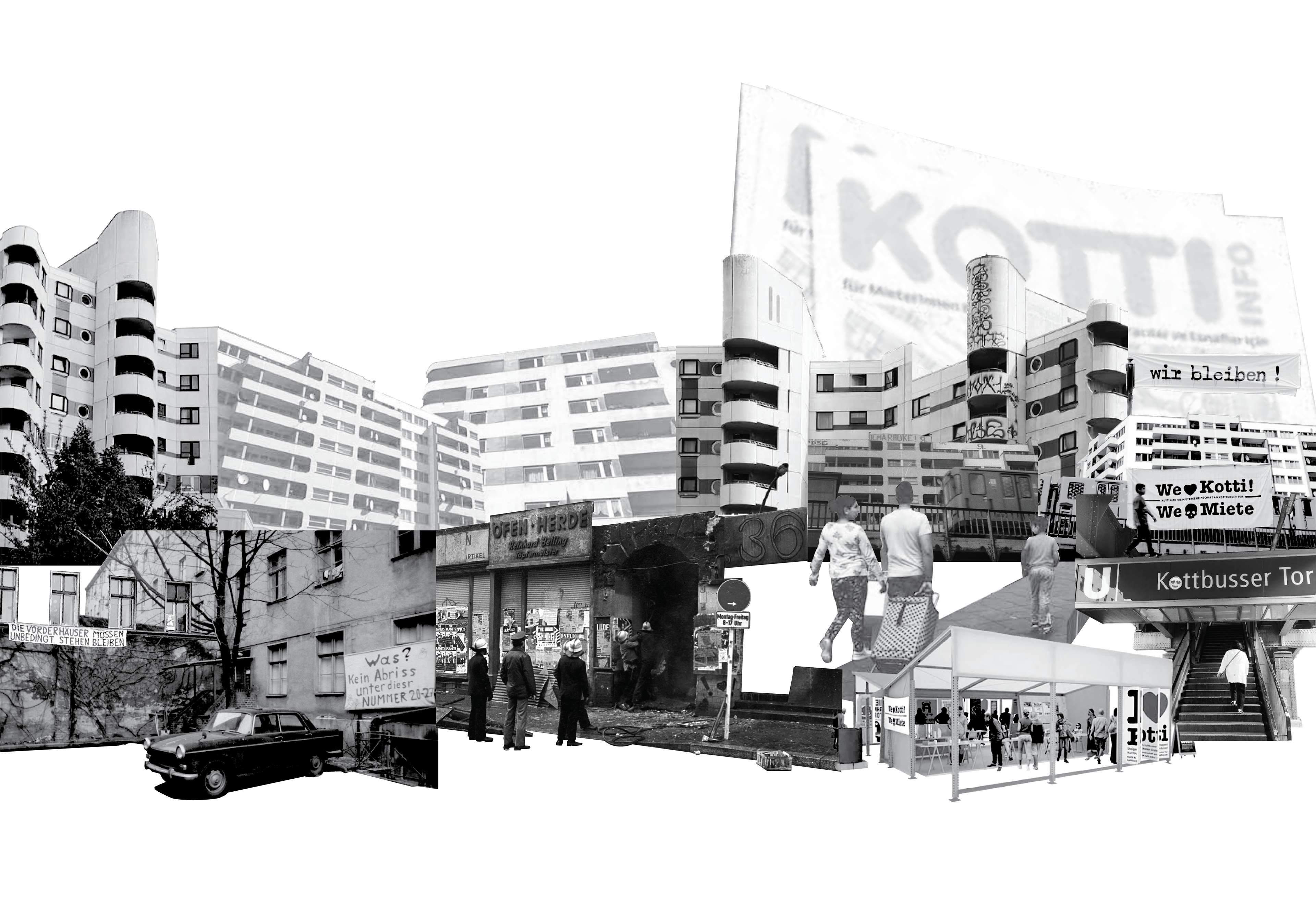
In the age of digital transformation, urban spaces must evolve to meet the needs of their residents. Traditional top-down urban planning models often fail to adapt to the dynamic and diverse nature of contemporary urban life.
How can digital tools enable self-organisation in urban planning and policy management, while empowering grassroots acts of local communities?
The challenge
Urban environments are increasingly shaped by profit-driven models that overlook the fundamental needs of local communities. This has led to social exclusion and a growing distrust in urban authorities. To address these challenges, there is a critical need for new methodologies that prioritize community engagement and inclusivity in urban planning.
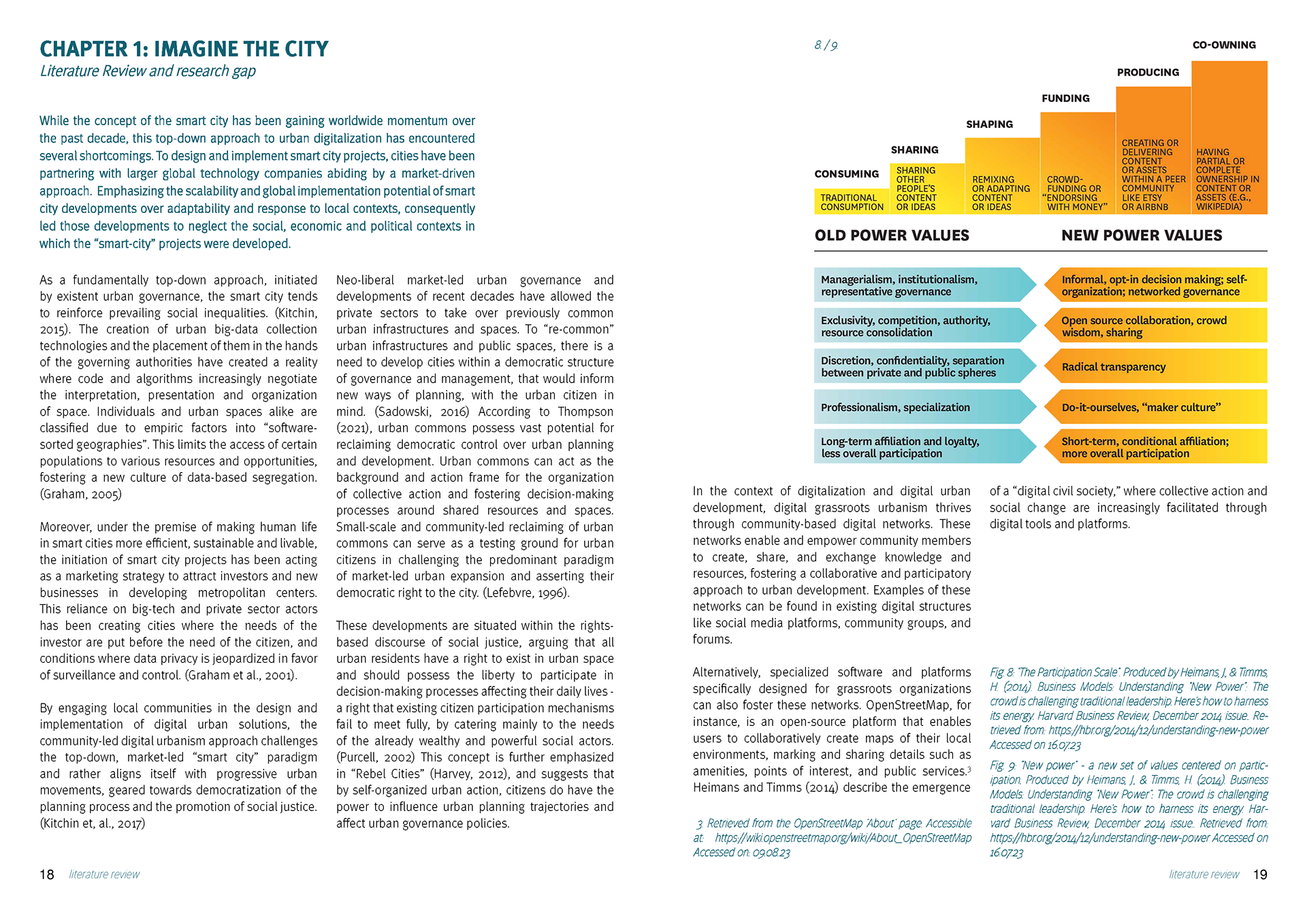
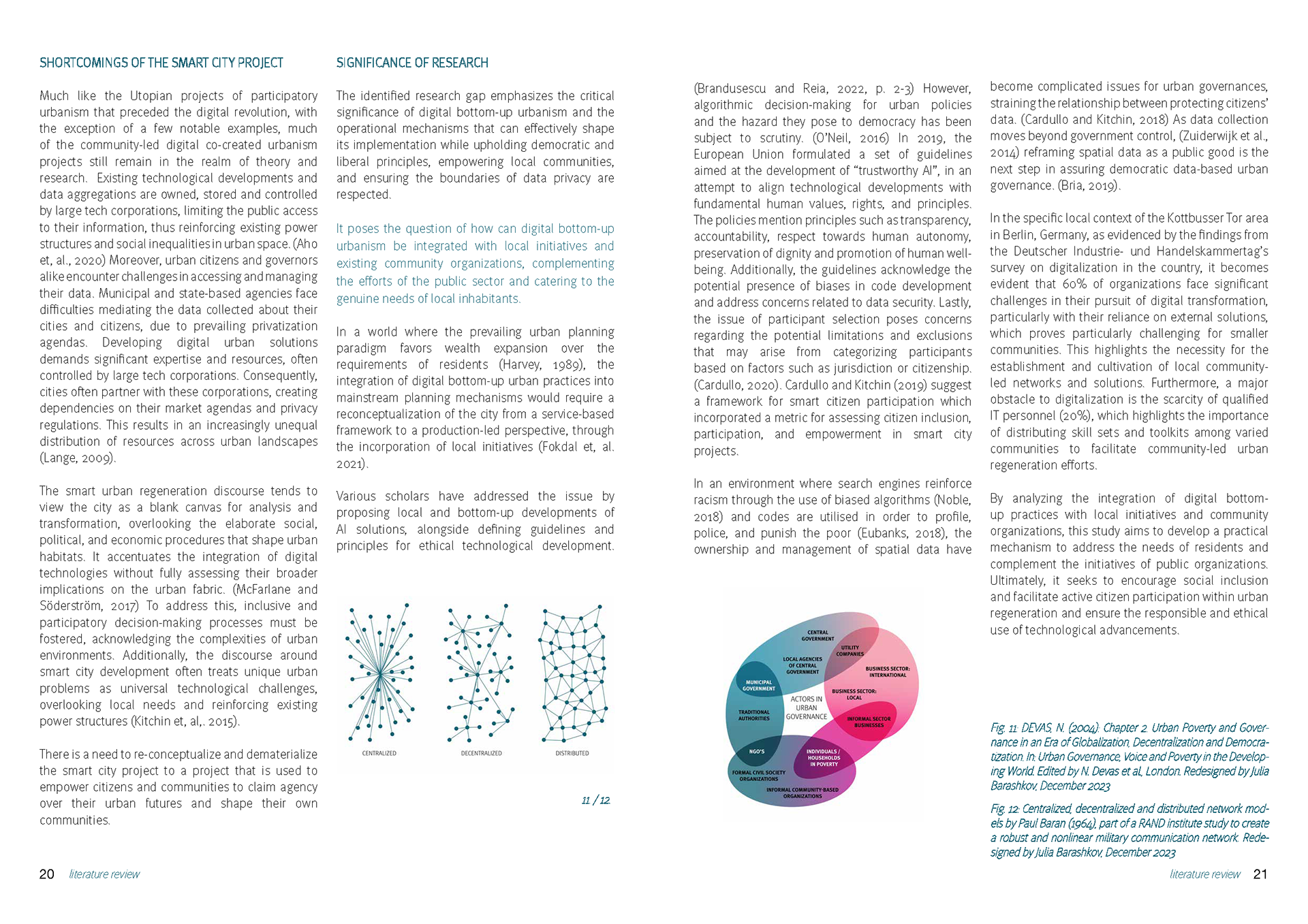
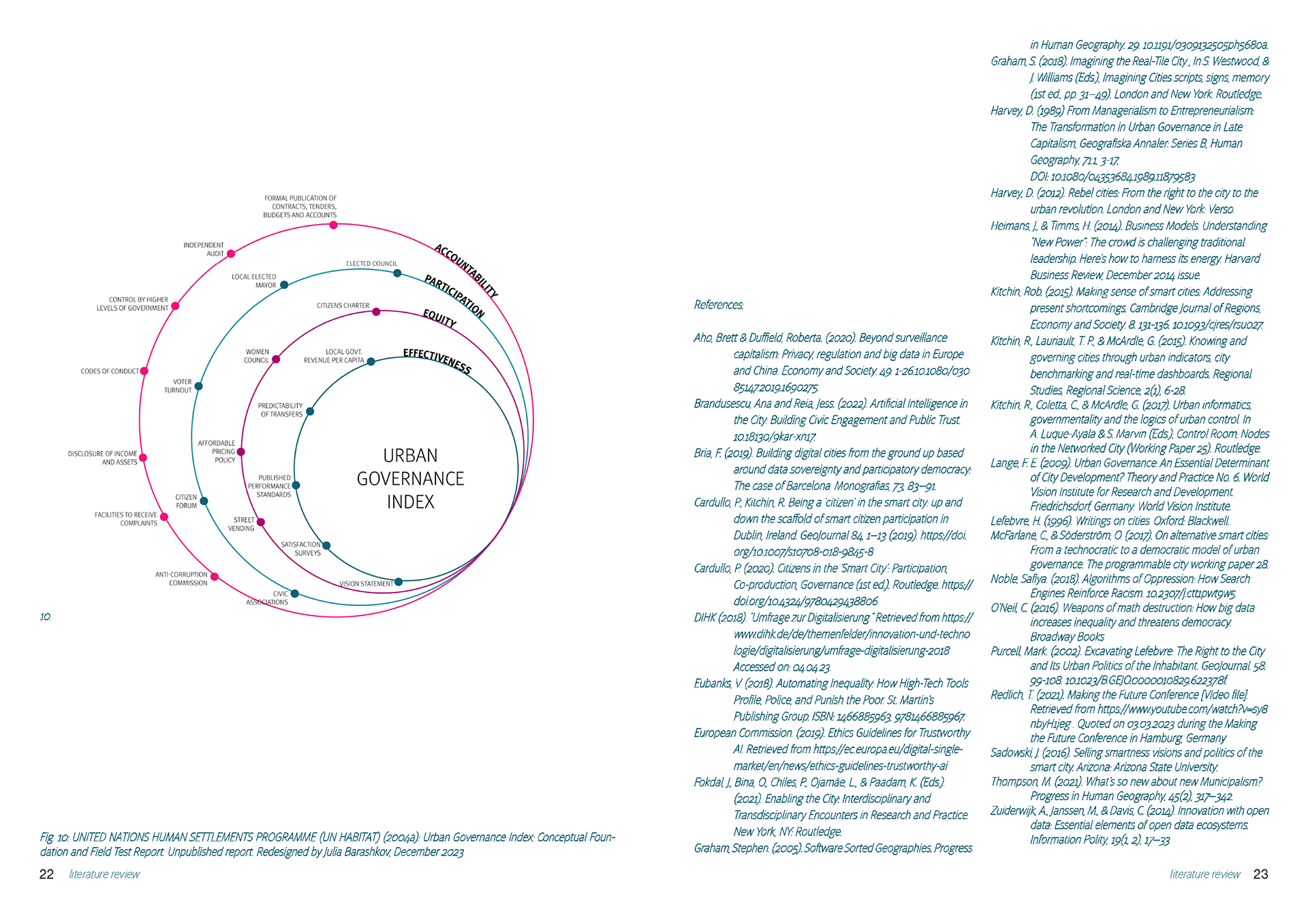
CHAPTER 1: IMAGINE THE CITY - Literature Review and research gap
While the concept of the smart city has been gaining worldwide momentum over the past decade, this top-down approach to urban digitalization has encountered several shortcomings. To design and implement smart city projects, cities have been partnering with larger global technology companies abiding by a market-driven approach. Emphasizing the scalability and global implementation potential of smart city developments over adaptability and response to local contexts, consequently led those developments to neglect the social, economic and political contexts in which the “smart-city” projects were developed.
The approach
My study focuses on Kottbusser Tor in Berlin, a popular yet contested urban area with a rich history of political activism. I integrated data analysis and simulation tools to build a framework for community-driven urban decision-making patterns. This involves:
- Analyzing urban dynamics through GIS data and open-source mapping platforms.
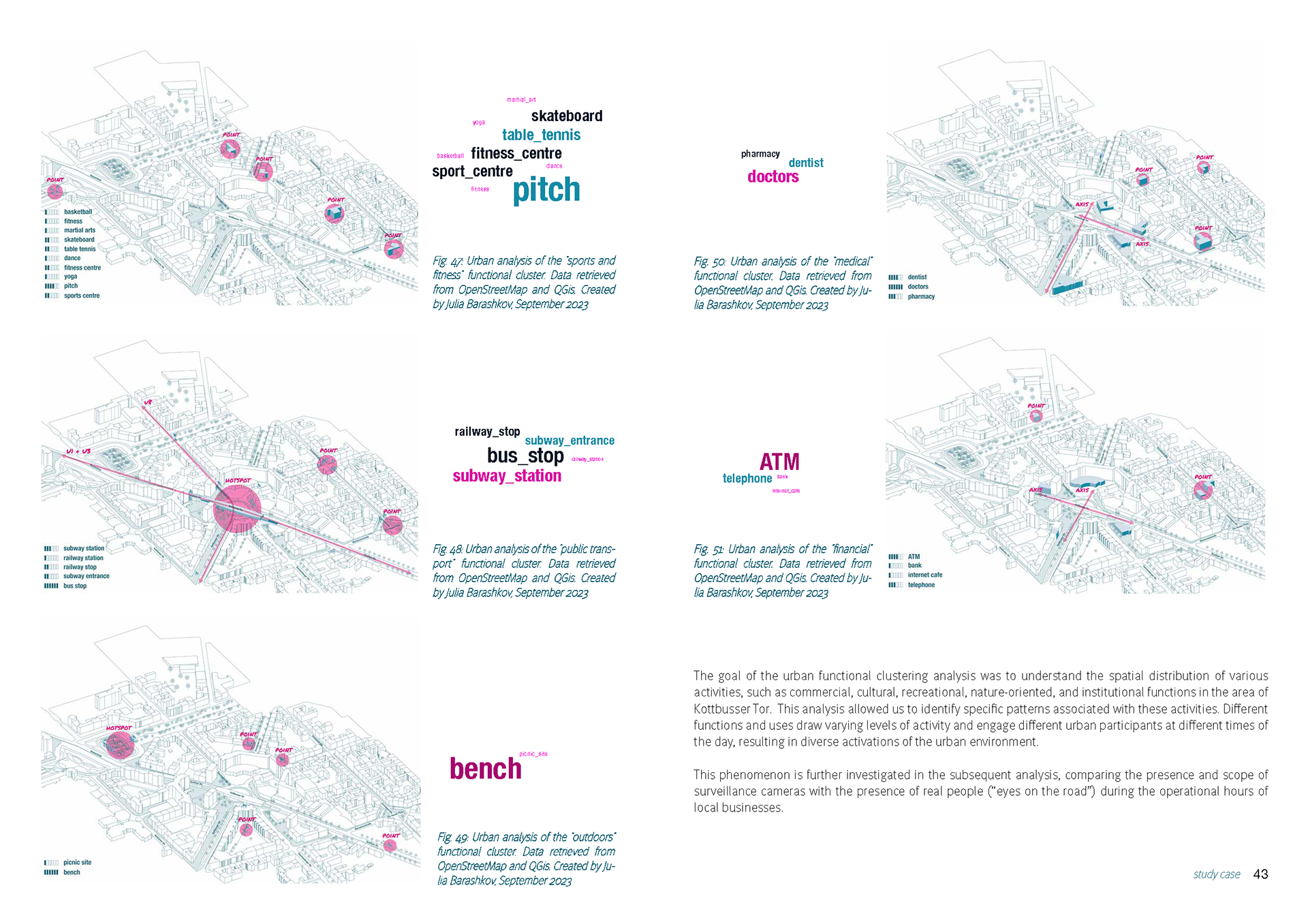
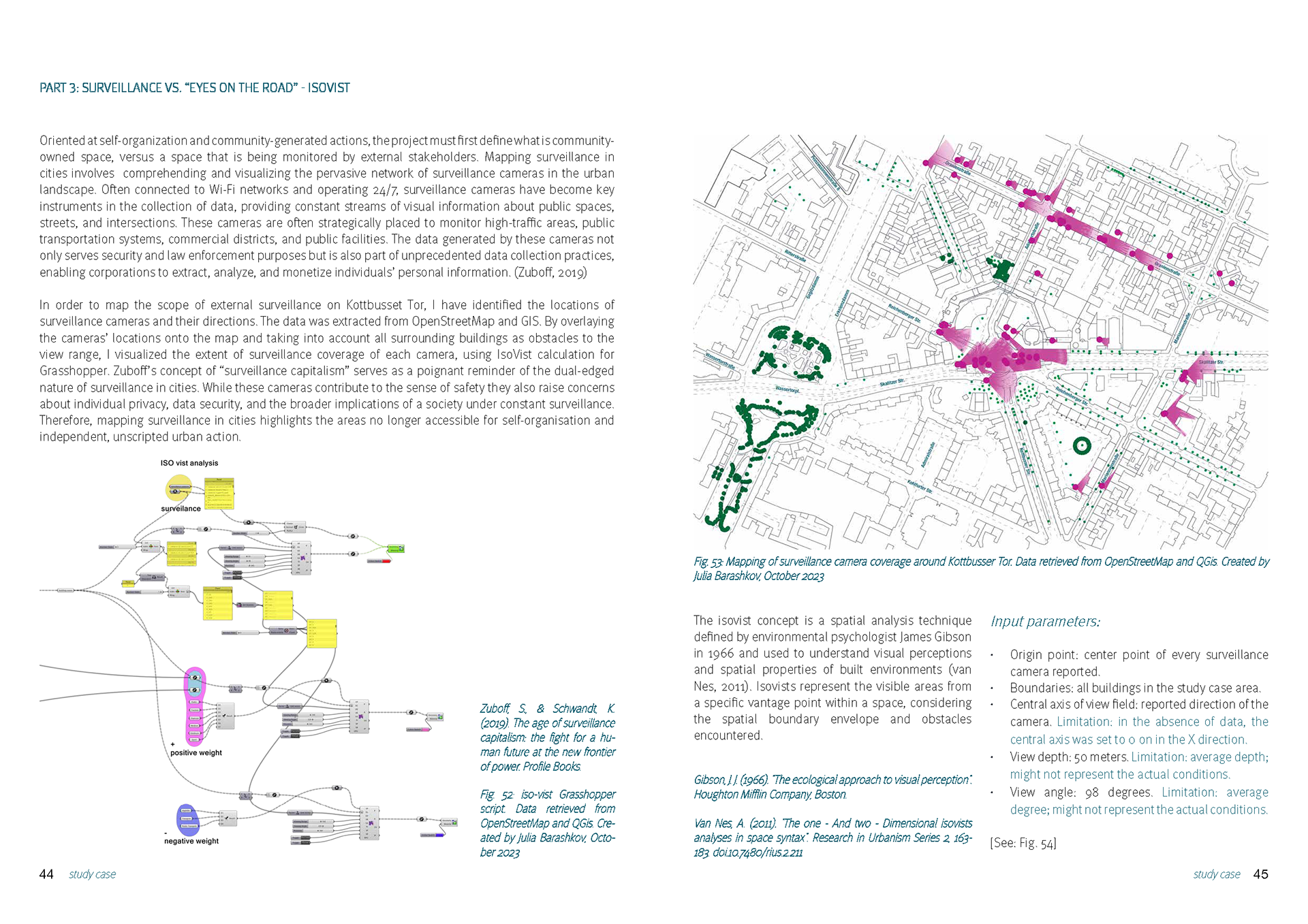
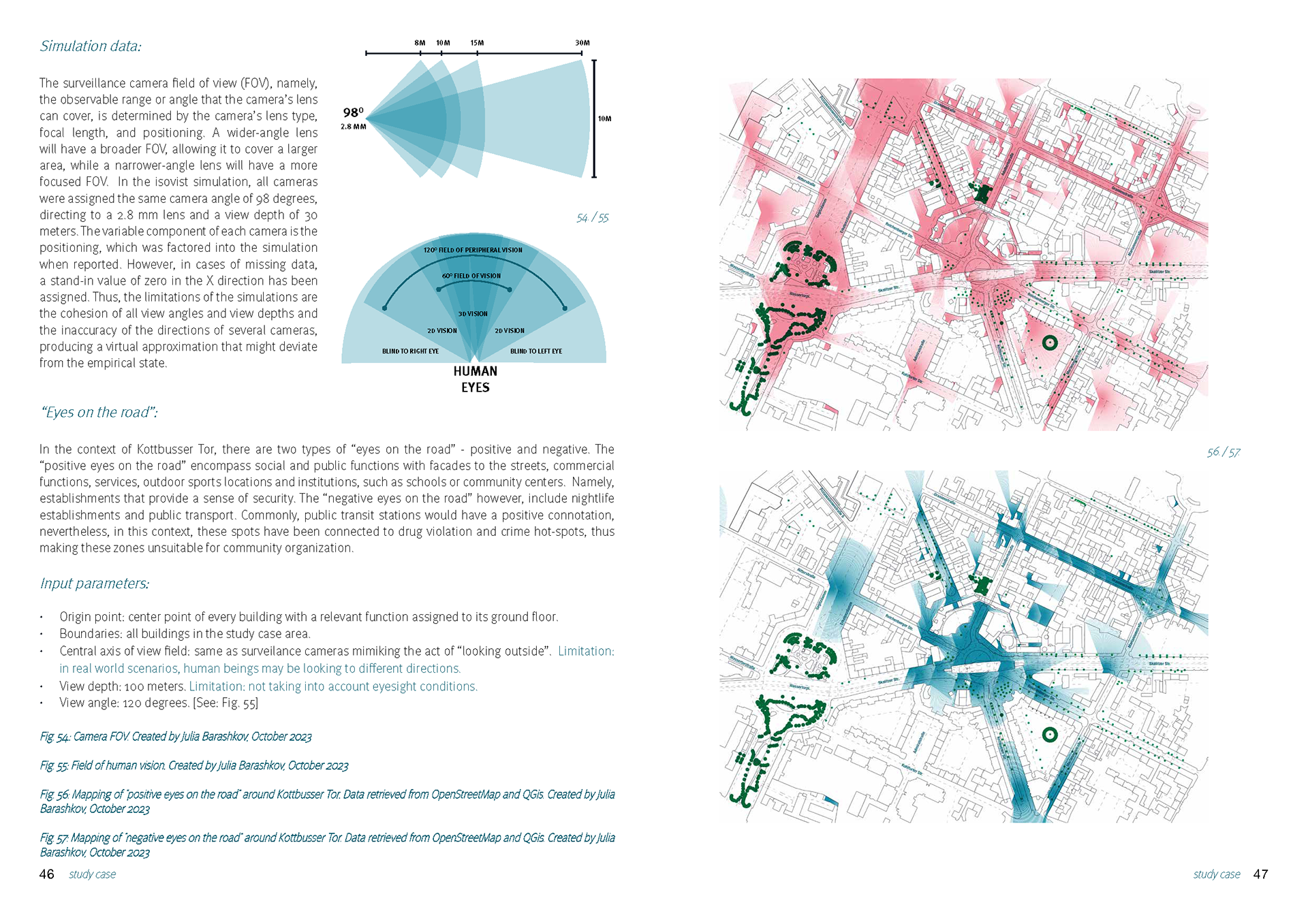
- Identifying key intervention areas by functional clustering and surveillance analyses.
- Outlining a localized online network to support community self-organization.
- Creating a strategy for spatial intelligence for temporary activities.
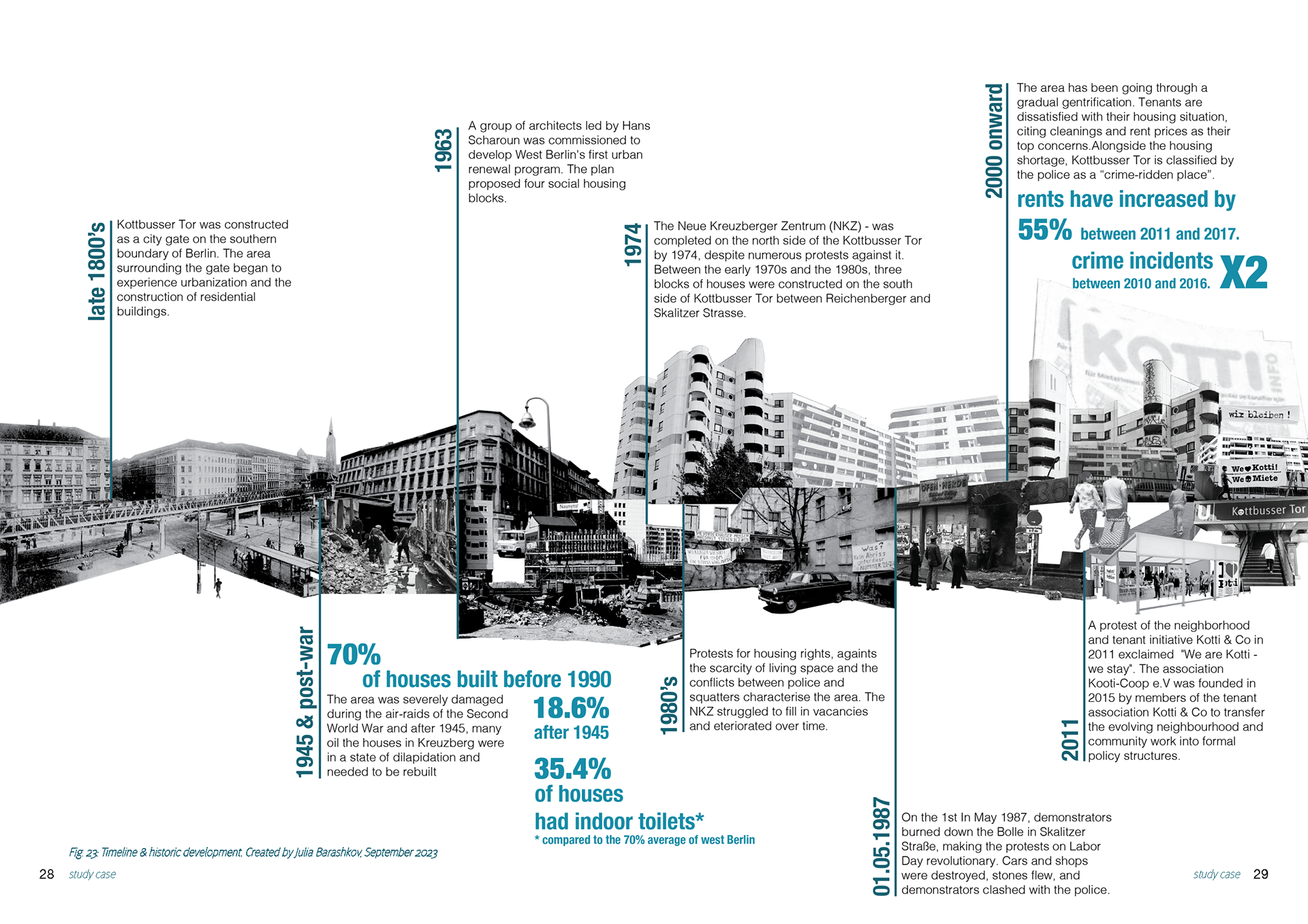
Timeline & historic development. Created by Julia Barashkov, September 2023
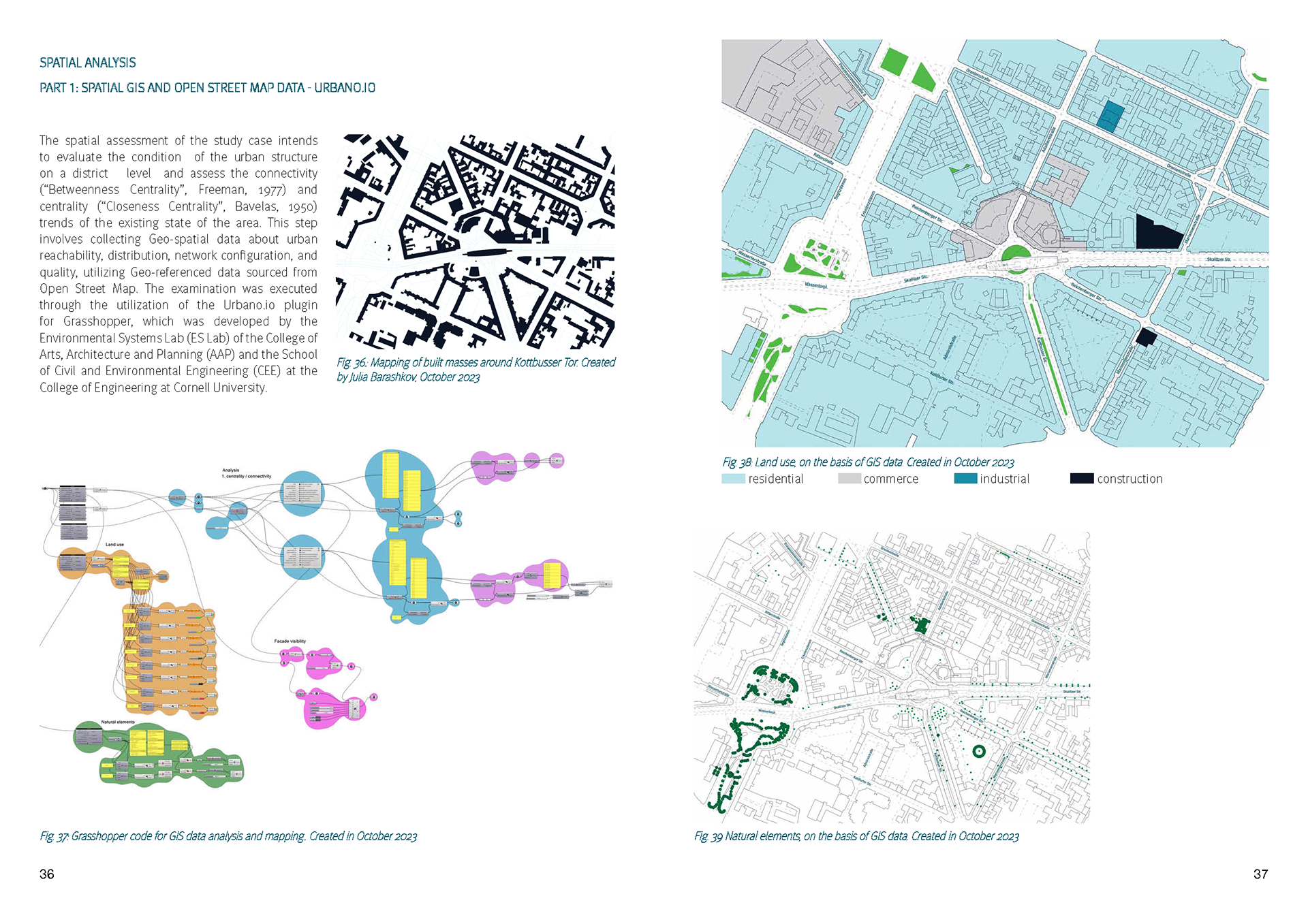
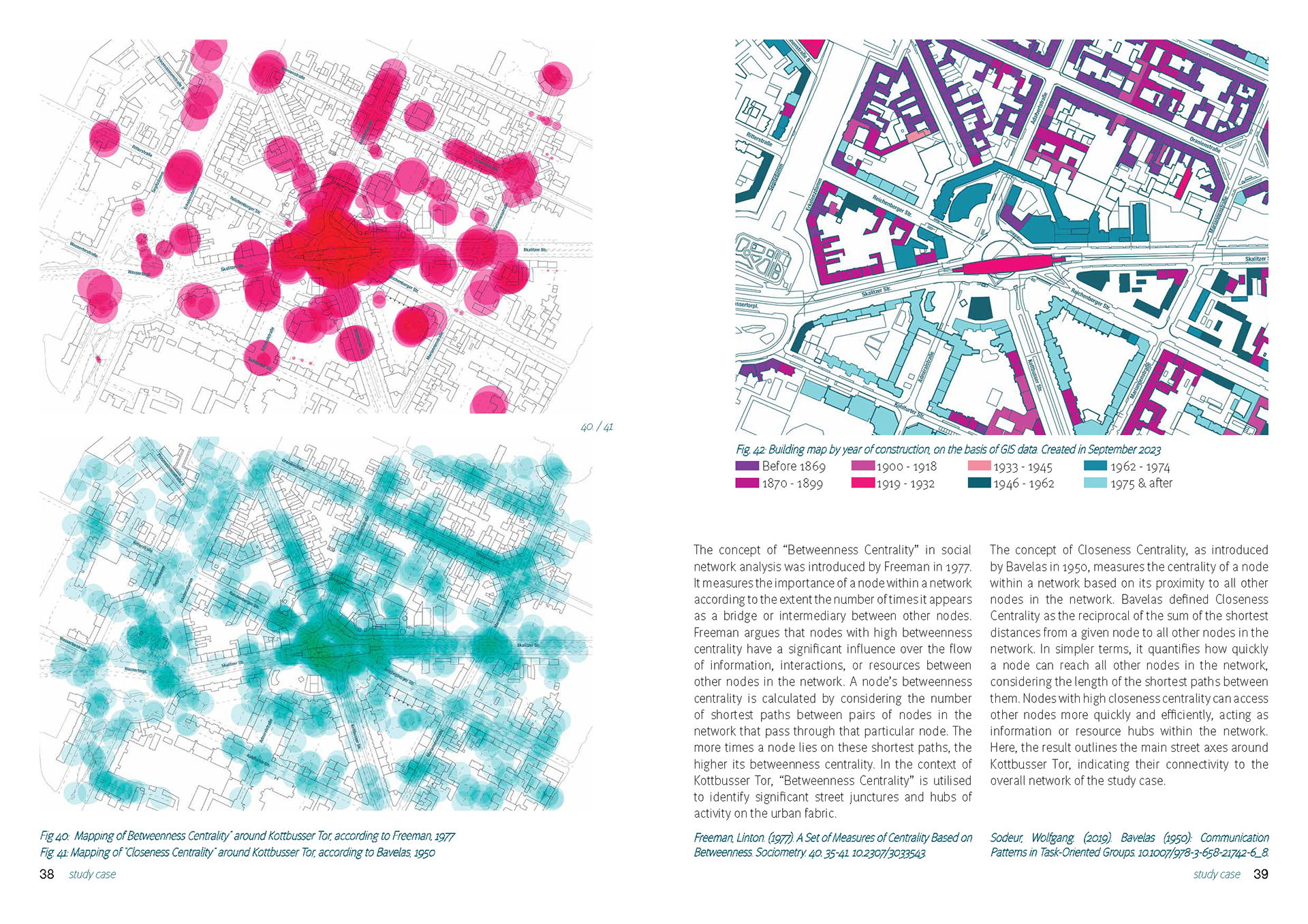
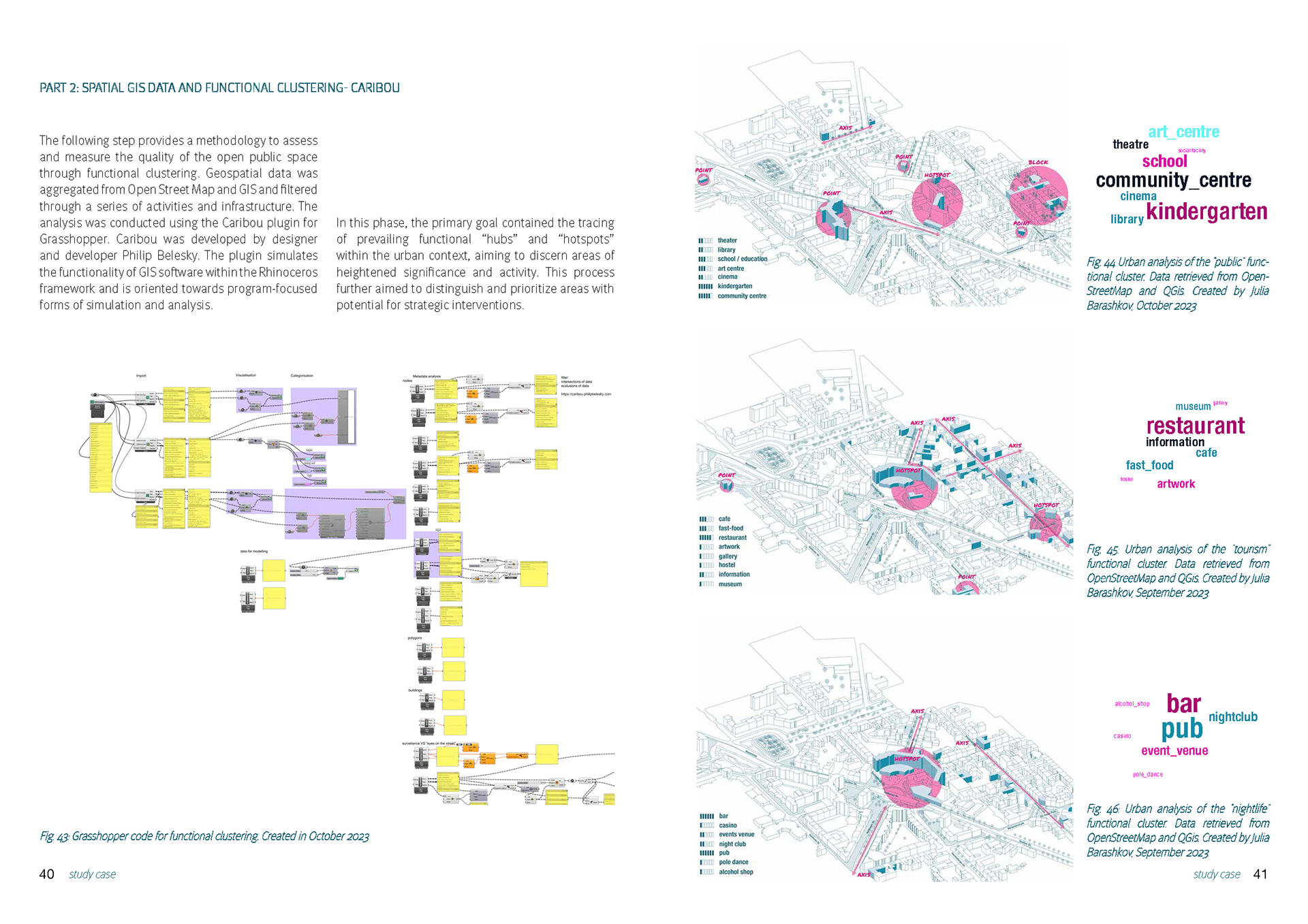
KOTTBUSSER TOR, KREUZBERG, BERLIN - Study Case
Urban spaces that have a history of self-organization serve as a dynamic stage upon which top-down endeavors meet bottom-up actions, showcasing the interactions and dynamics between these two approaches. Kottbusser Tor, a prominent square located in the heart of Berlin, Germany, stands as a fascinating case study for investigating the multifaceted nature of self-organized urban transformation. Located in the borough Friedrichshain-Kreuzberg, and south of Mitte, Kreuzberg holds a cultural significance.
Local spatial intelligence - People / Cities / Behaviour
- Challenging the traditional view that the physical layout defines a city. (Ellingham and Fawcett 2006; Lynch 1984; Proshansky, Ittelson et al. 1970; Tabor 1976; and Weeks 1960)
- Cultural, functional, and societal factors affect the interconnection between urban spatial design, human behavior (Rapaport, 1977; Lefebvre, 1974), and digital technologies. (De Lange and De Waal, 2013)
- Urban social networks impact social capital, act as "third spaces" that catalyze collective action. Location awareness in public spaces adds a layer of complexity and locality to their management.
- Urban social networks impact social capital, act as "third spaces" that catalyze collective action. Location awareness in public spaces adds a layer of complexity and locality to their management.
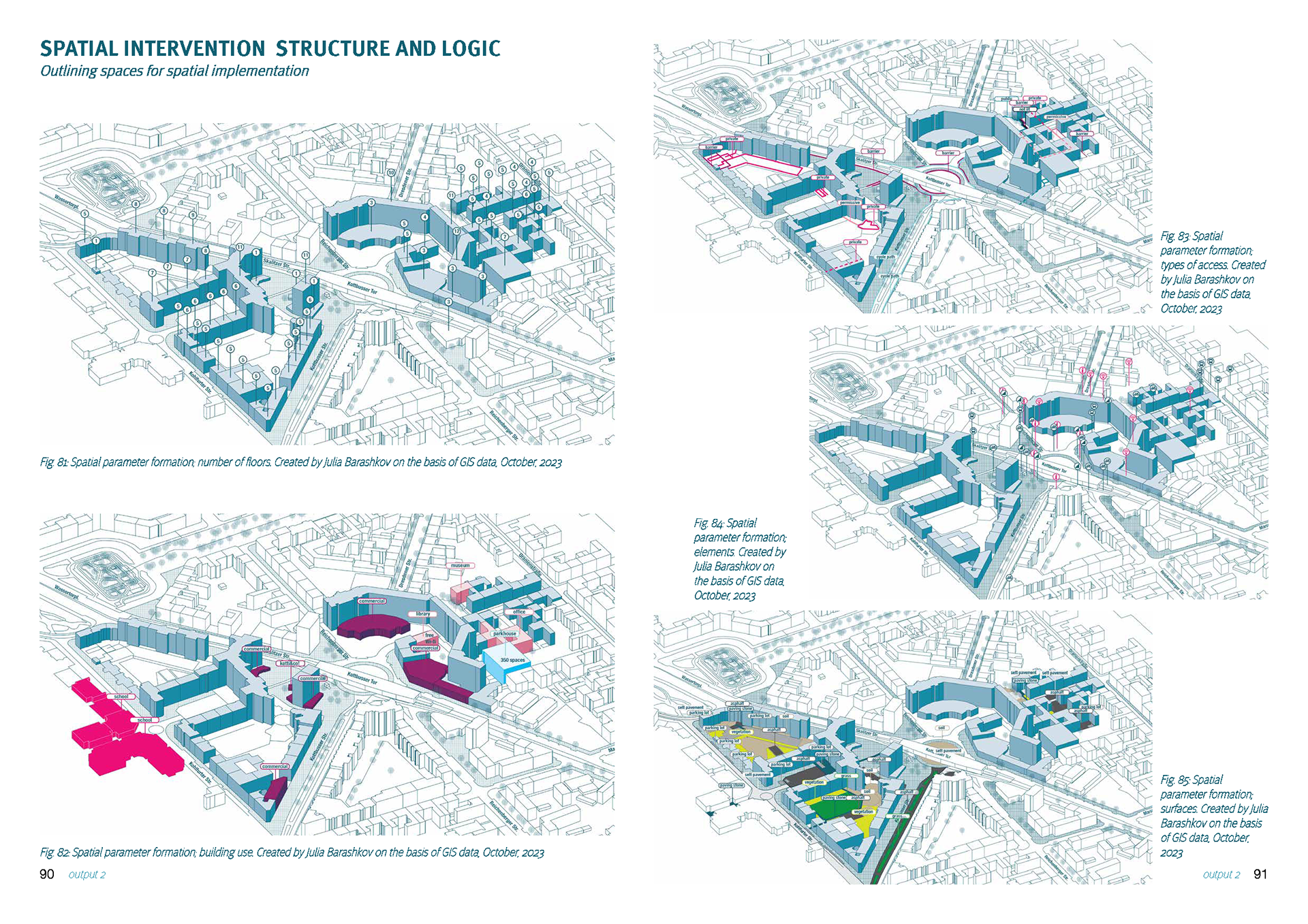
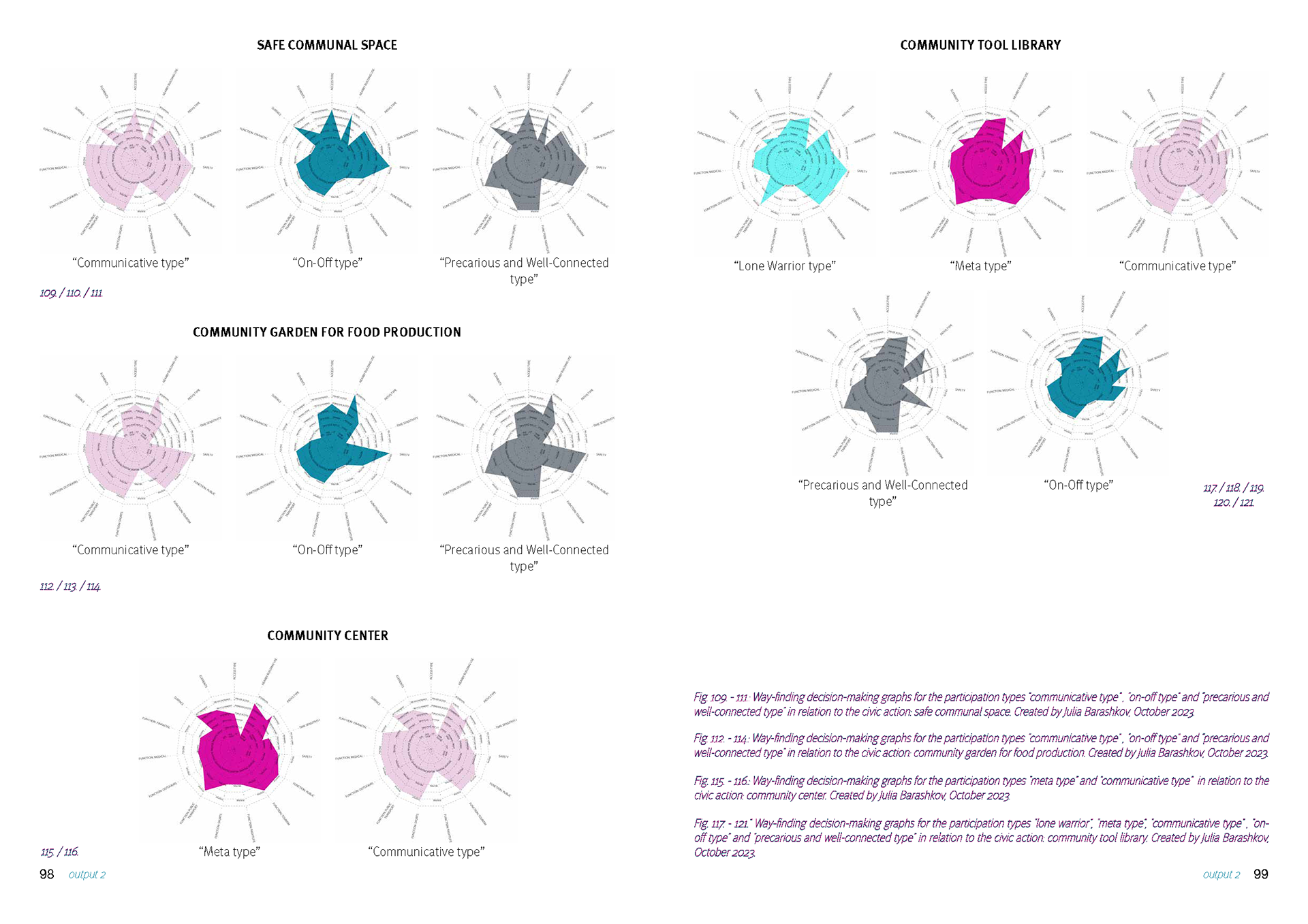
NEIGHBORHOOD STRATEGY FOR SELF - ORGANIZATION - Intelligence for intervention location selection
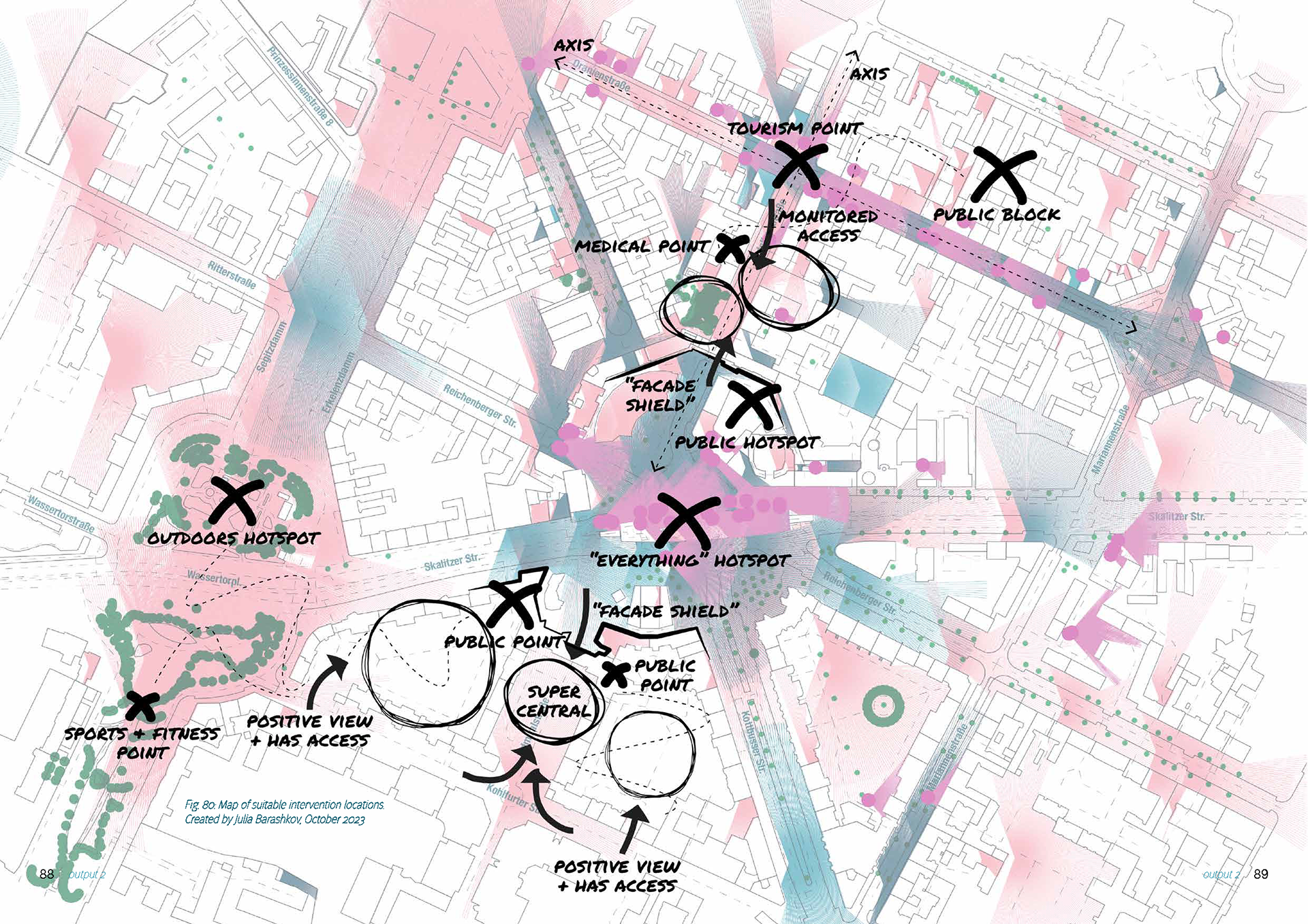
This chapter addresses a gap in the current theoretical landscape of social and community - driven initiatives: originating from local endeavors, these actions lack a well-defined guideline for determining the optimal locations for them to occur. The quest to effective self organization requires spatial intelligence, the skill set to select intervention location that would allow for community - driven actions to materialize and occur. This is achievable through a comprehensive spatial rationale, taking into account various aspects of navigation and activity formation in urban spaces.
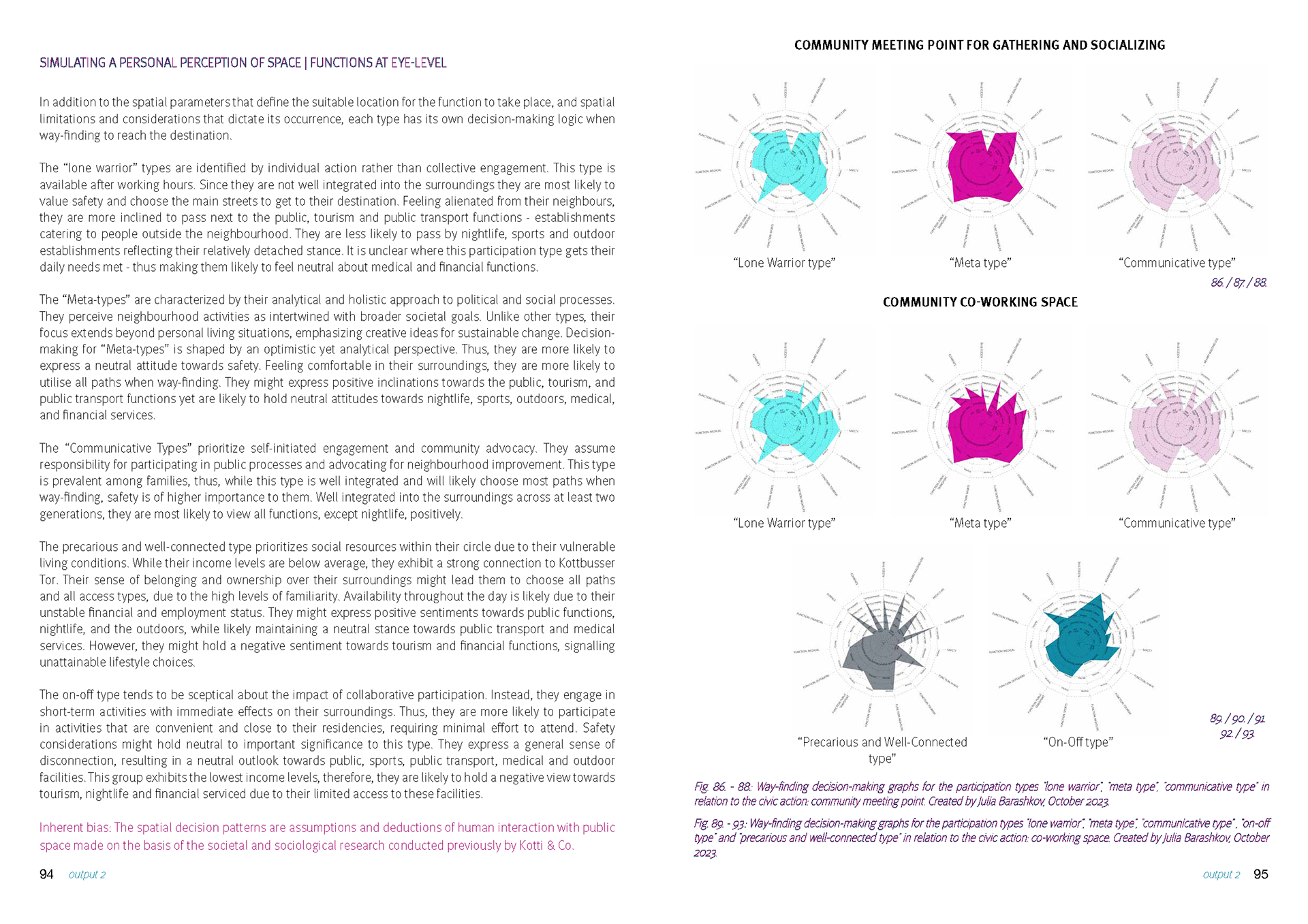
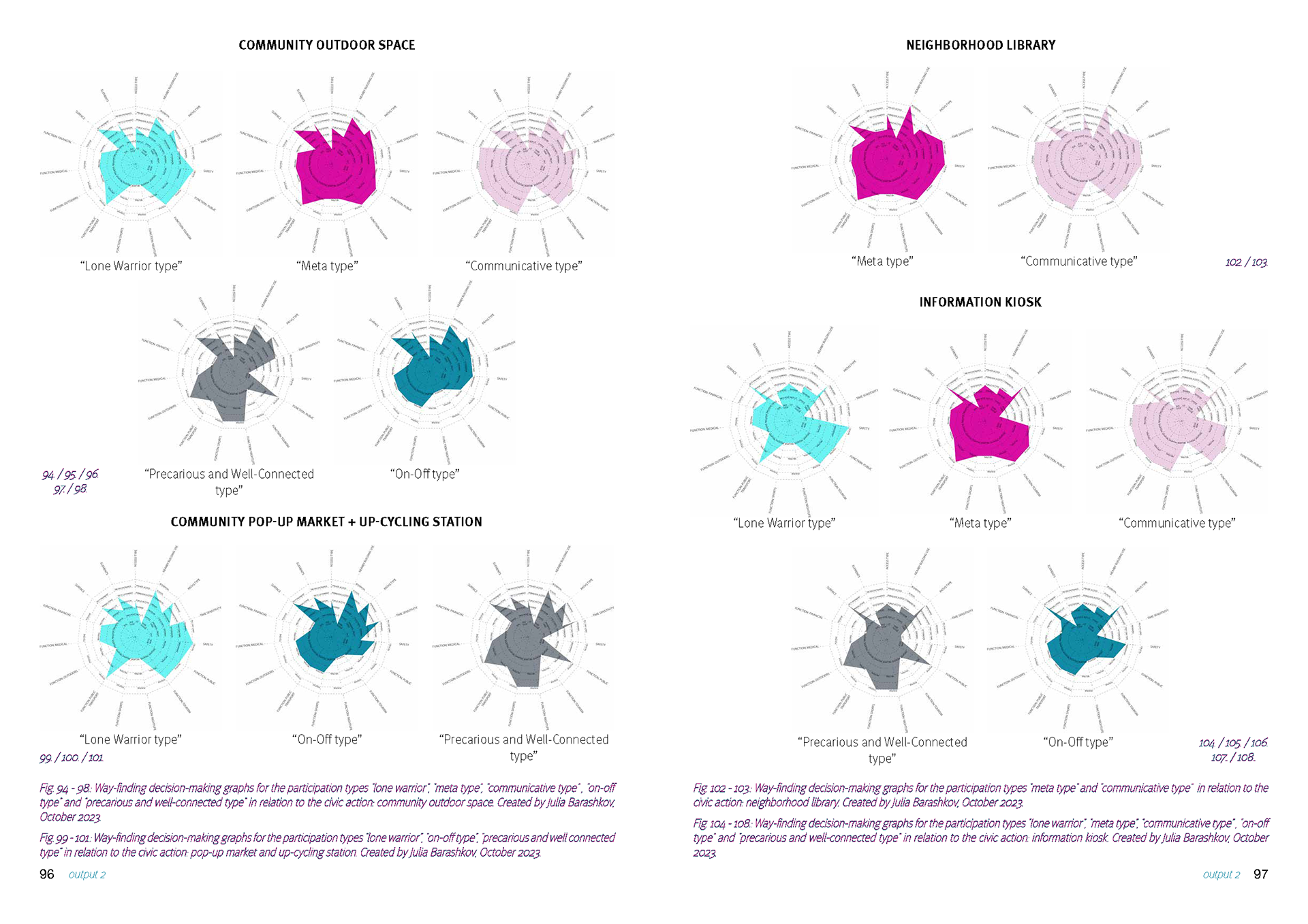
Impact of personality on space
Simulating human activity in urban space, Space Syntax represents movement in the context of network structure, spatial relations, and interpretive models.
An unweighted city graph takes into account “closeness centrality” (Bavelas, 1950) and “betweenness centrality” (Freeman, 1977).
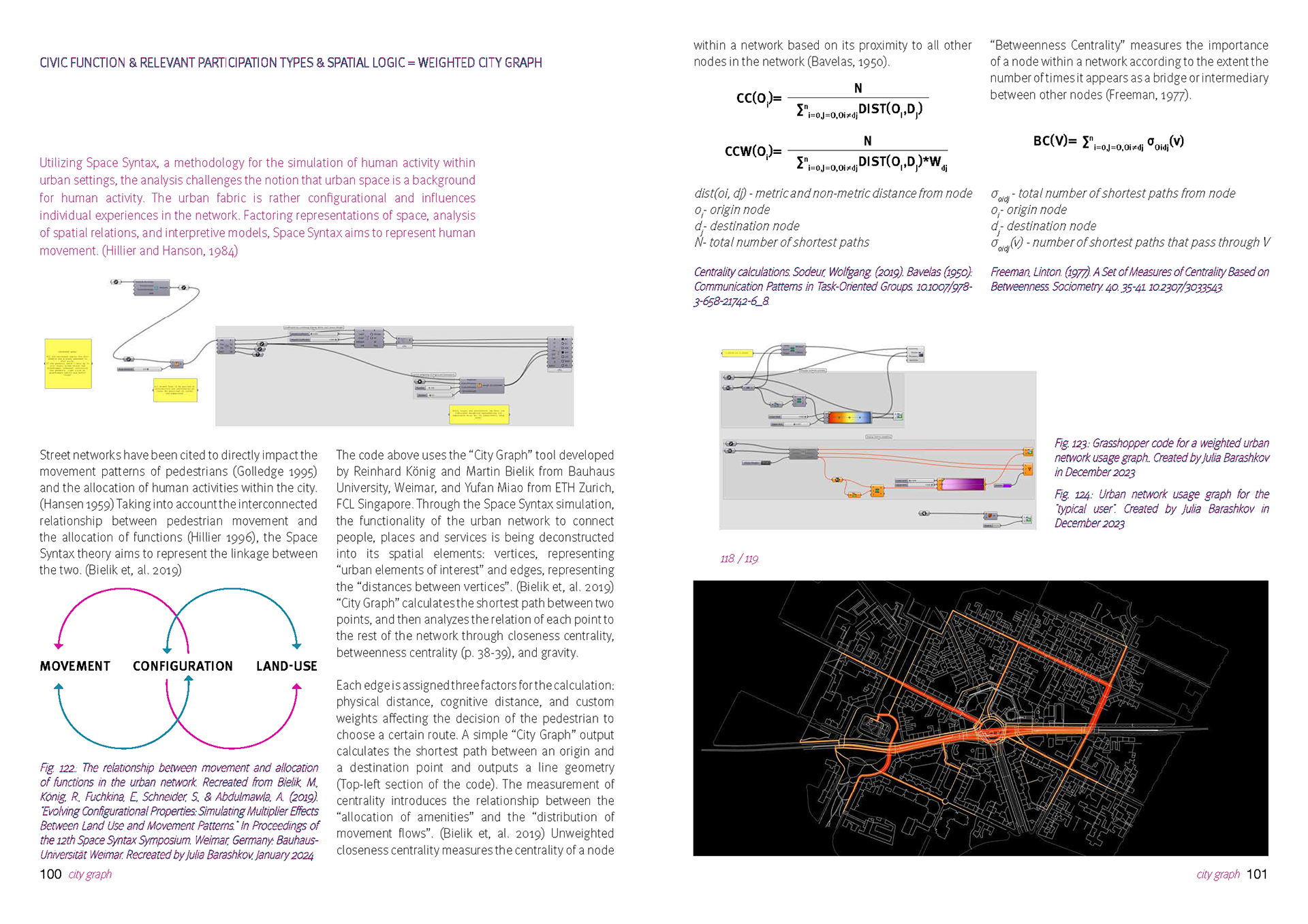
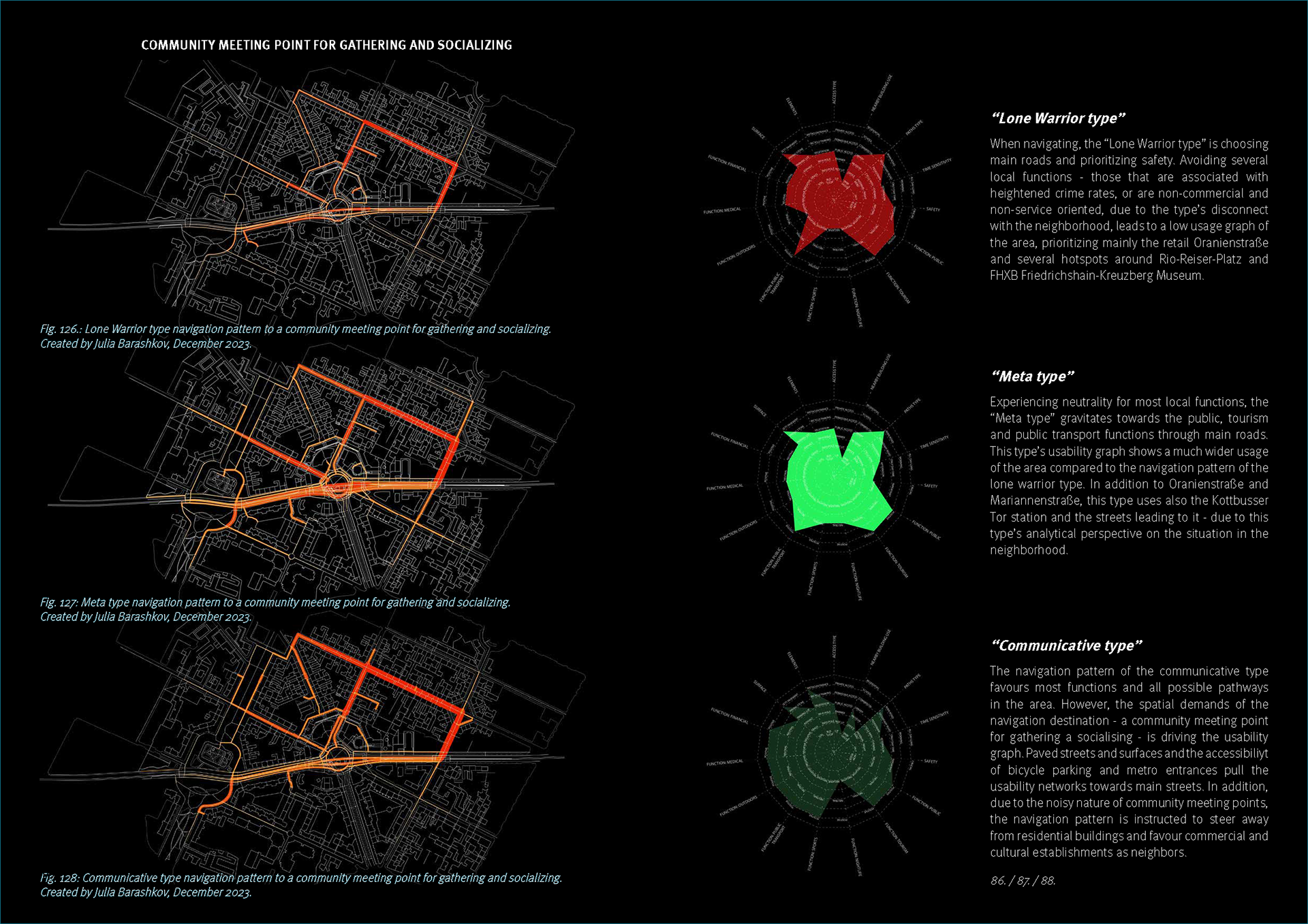
Each participation type’s decision making process was simulated to visualise the impact of personal preferences on navigation patters.
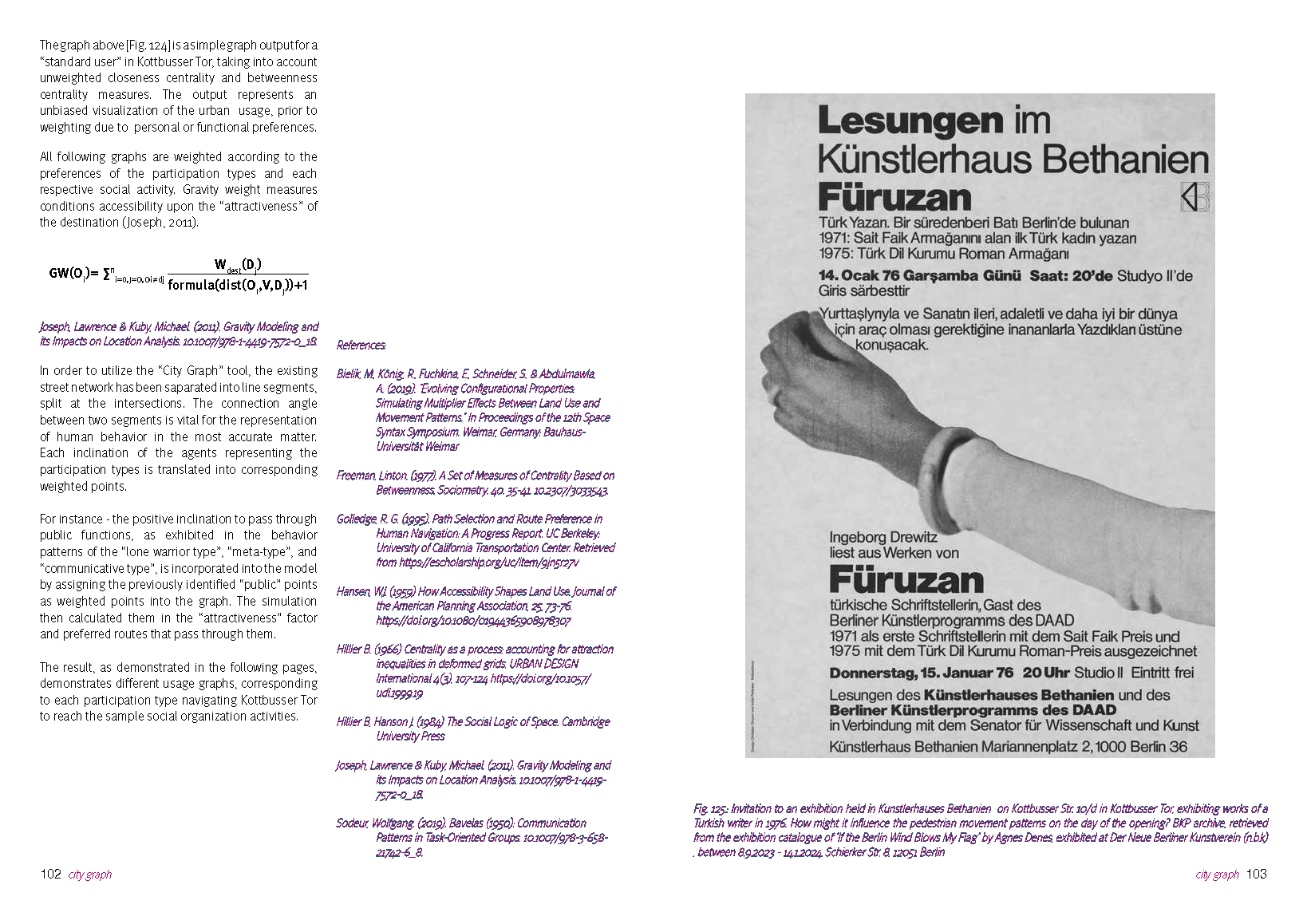
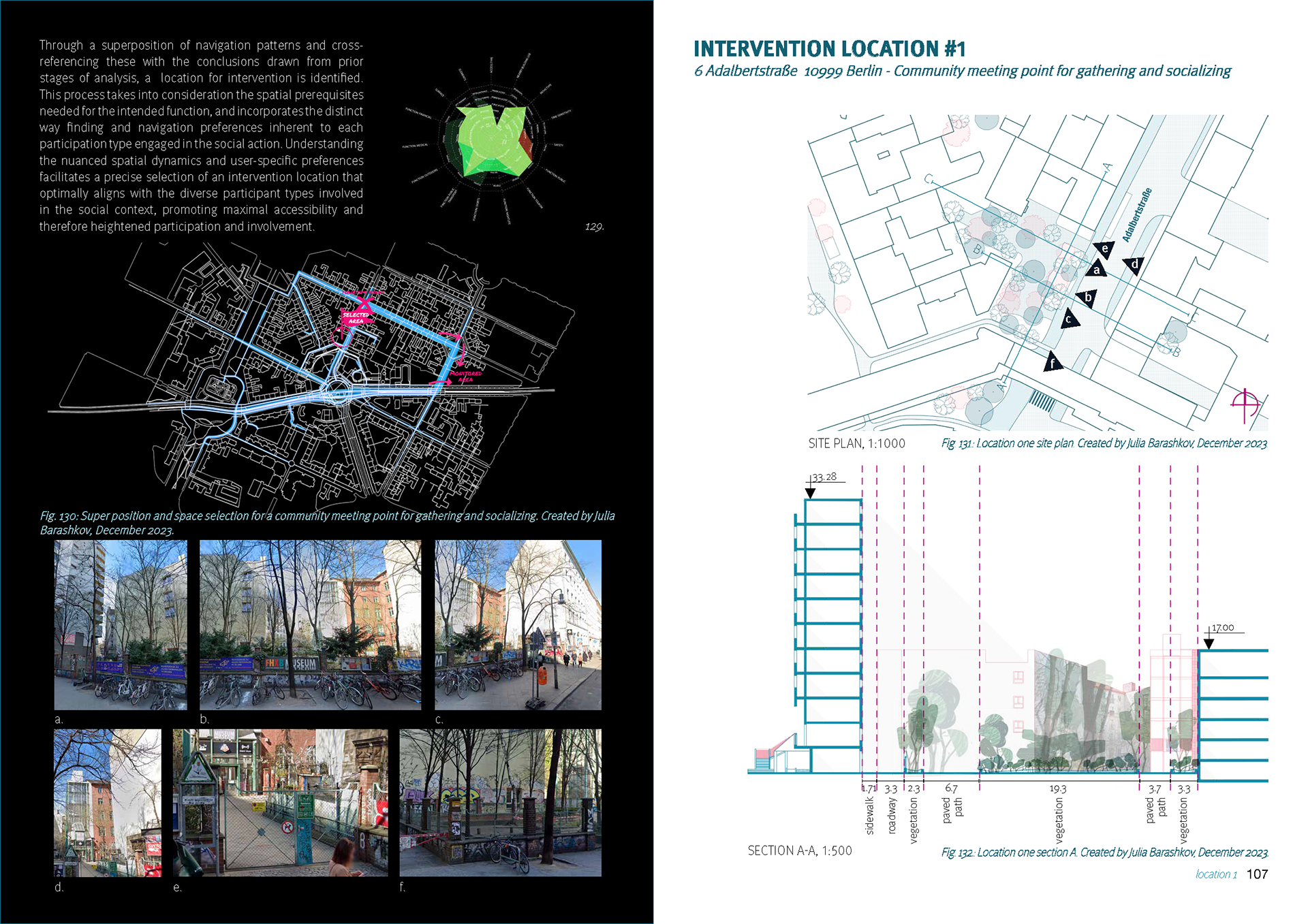
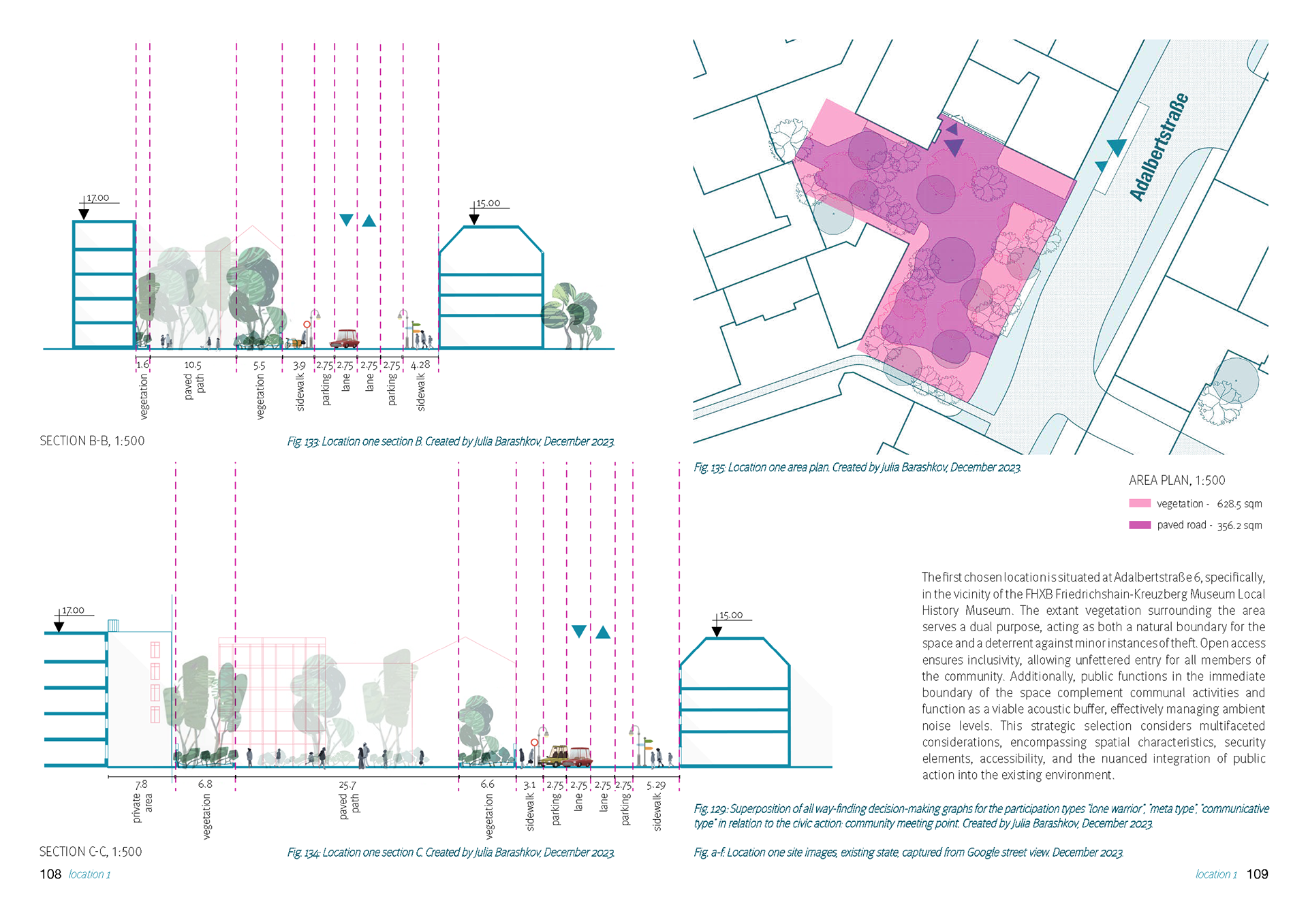
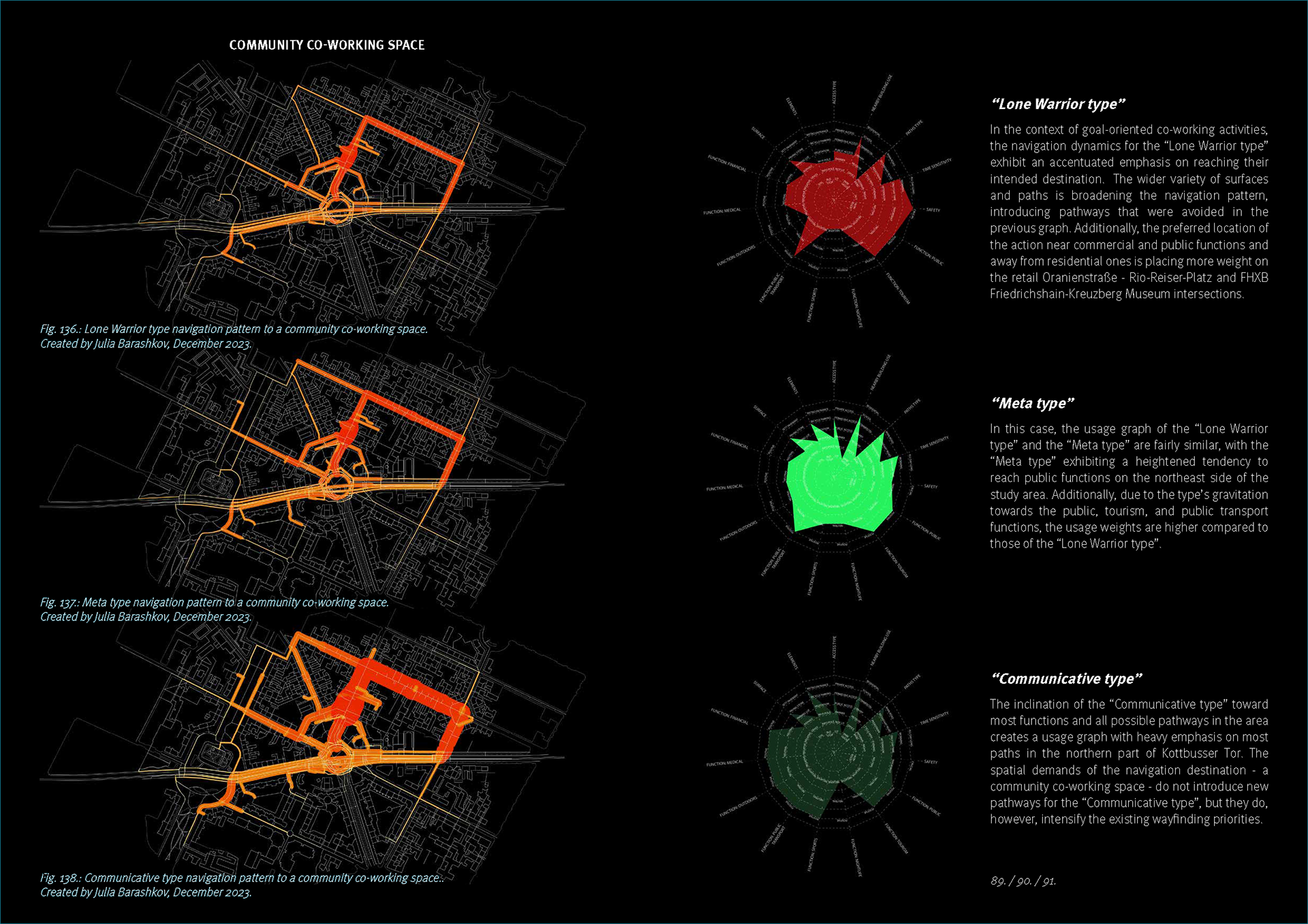
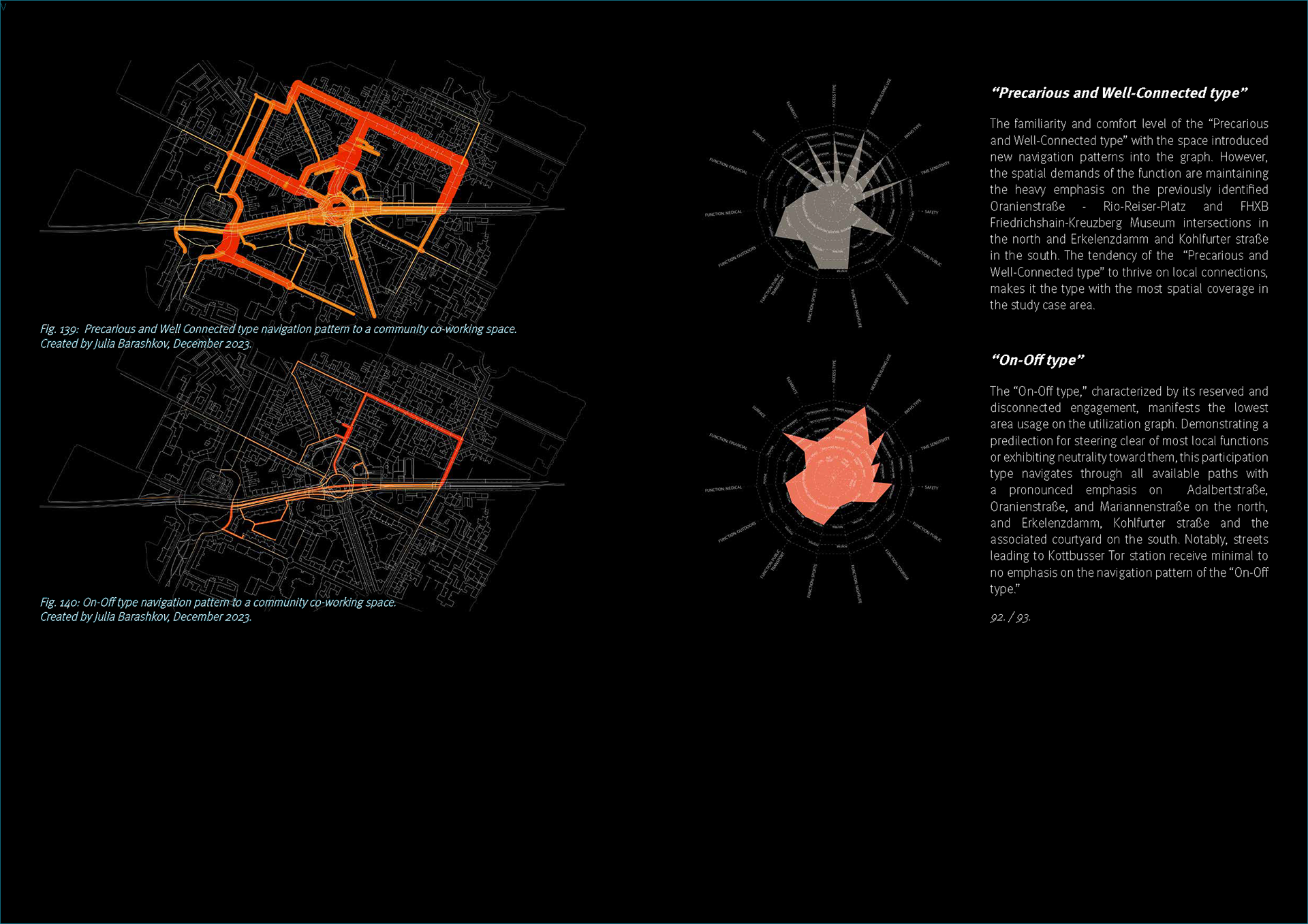
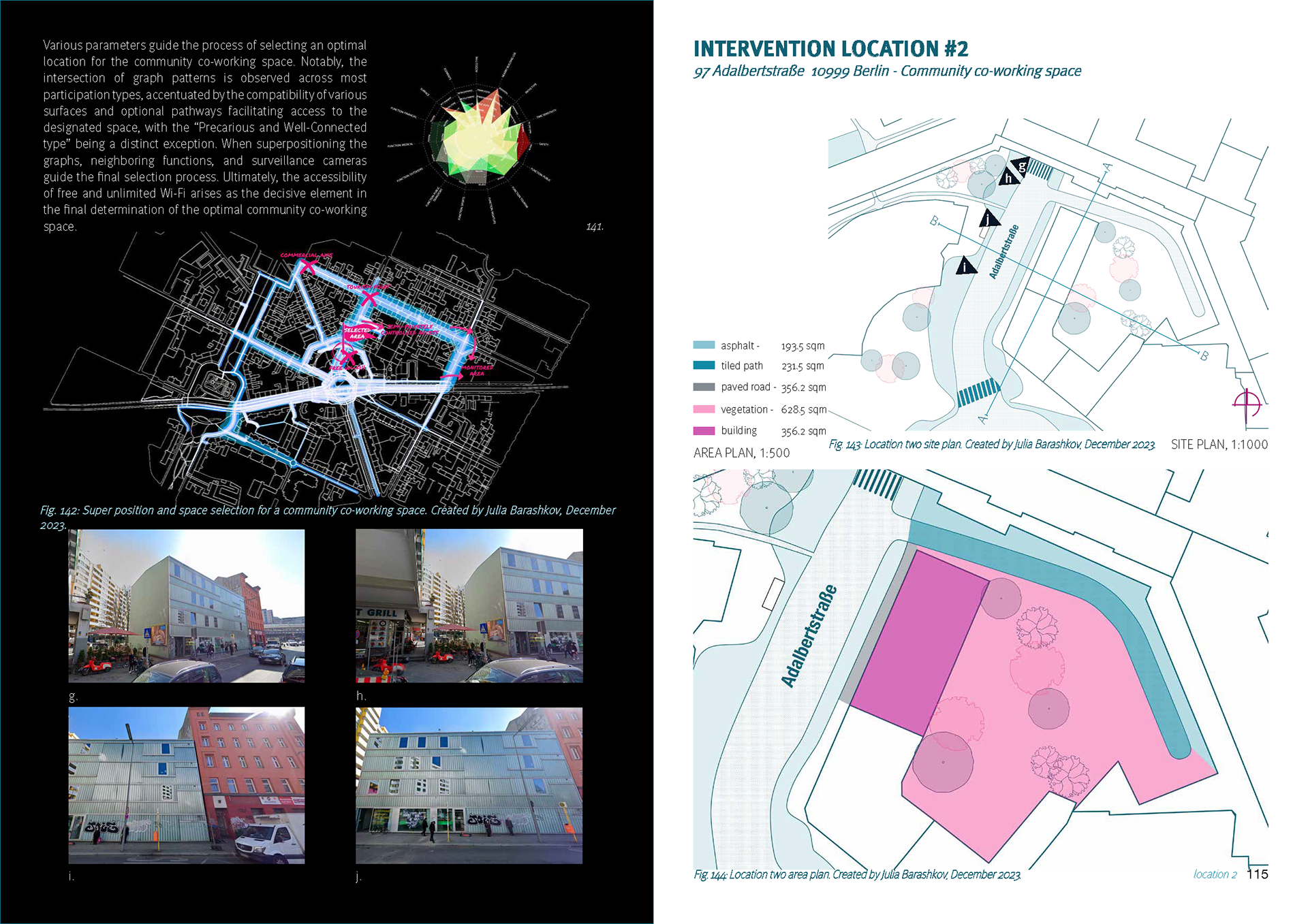
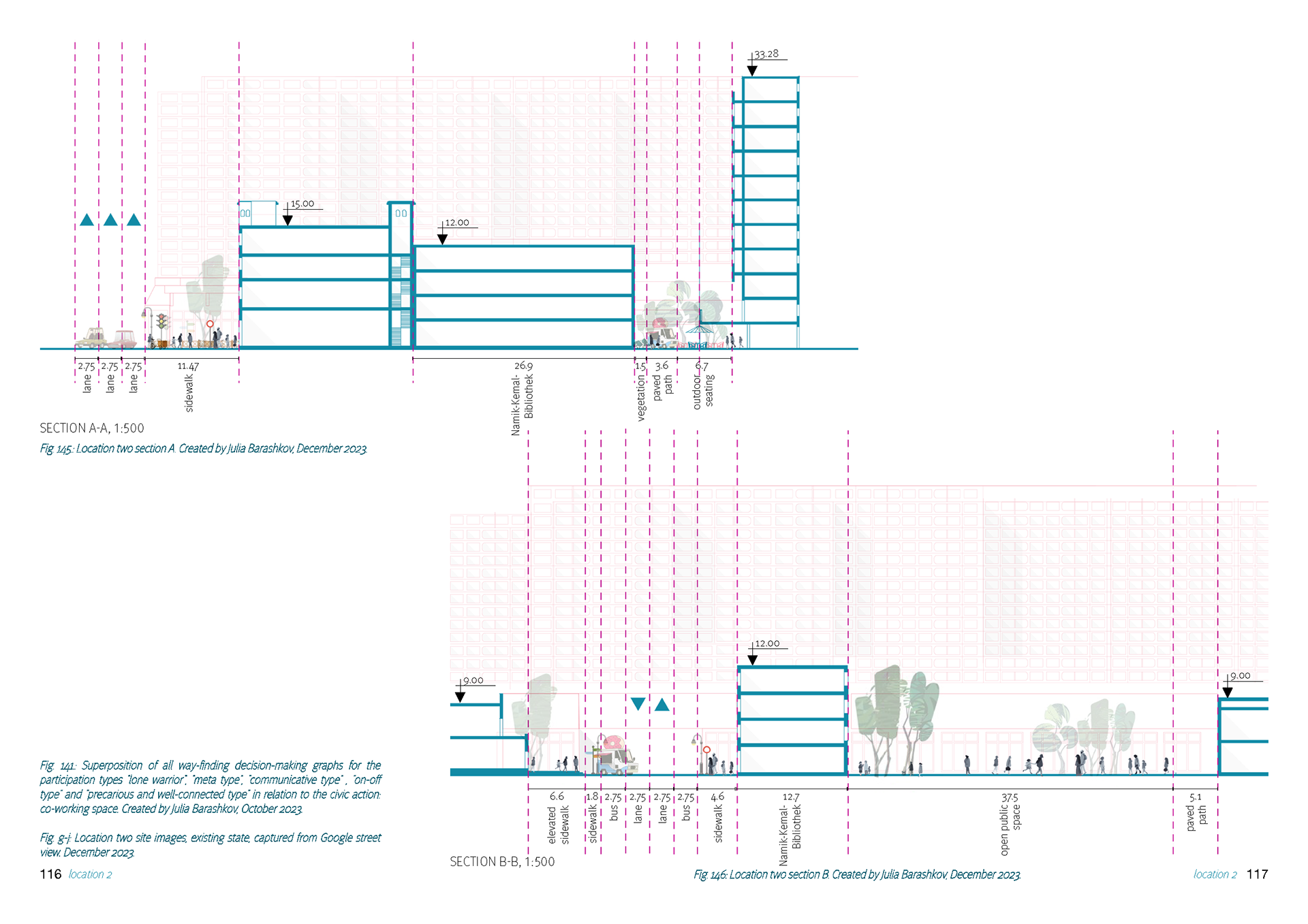
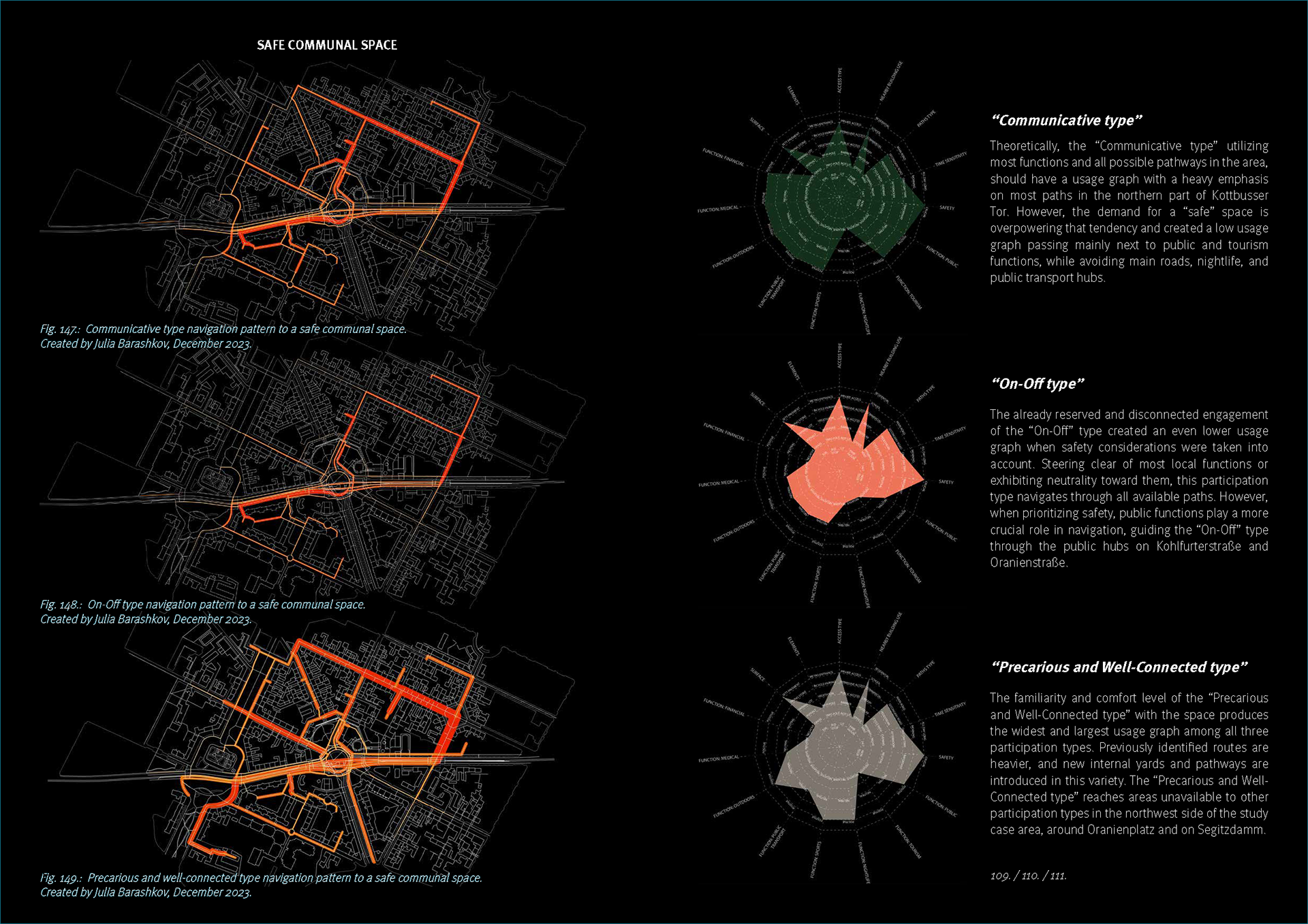
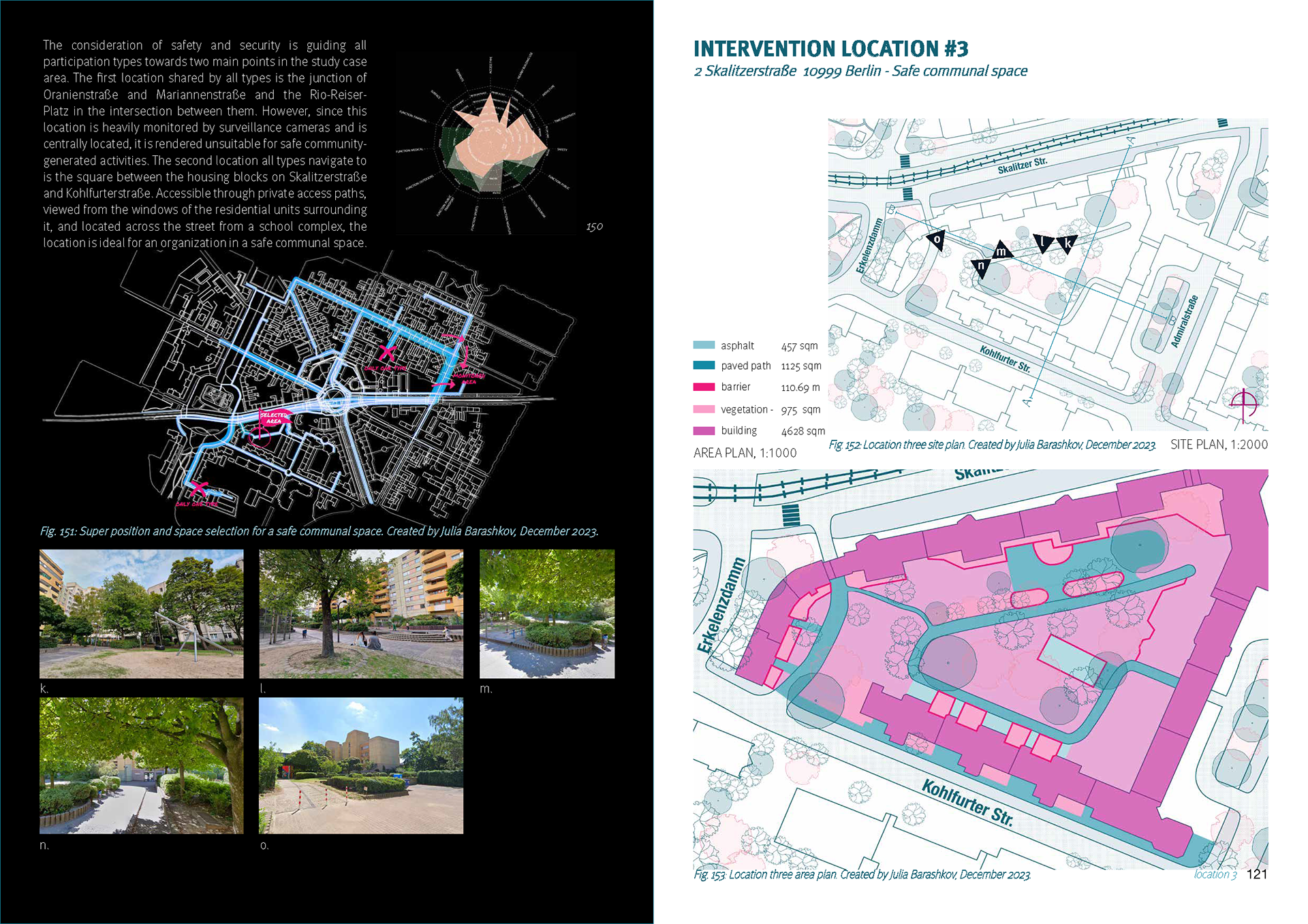
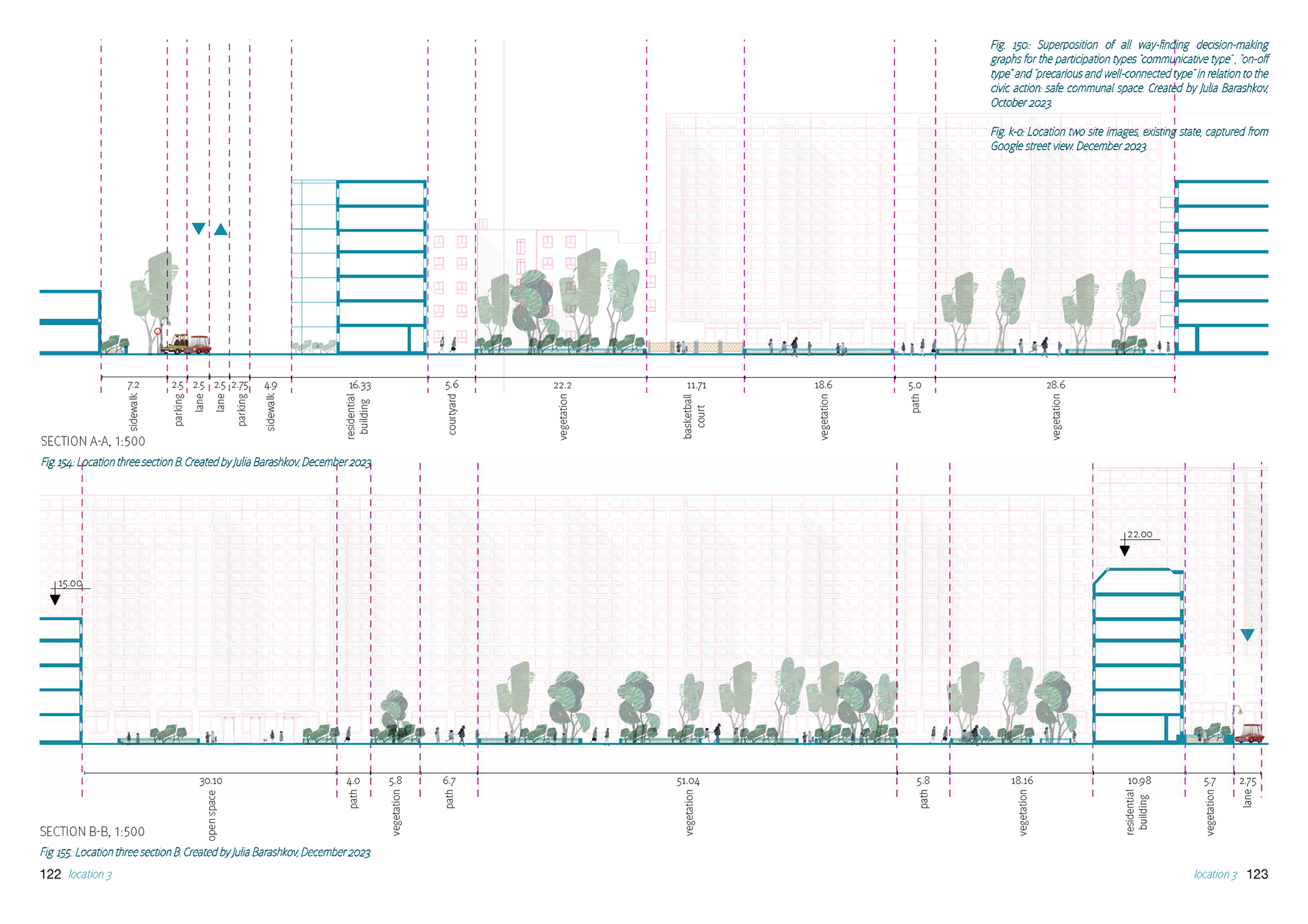
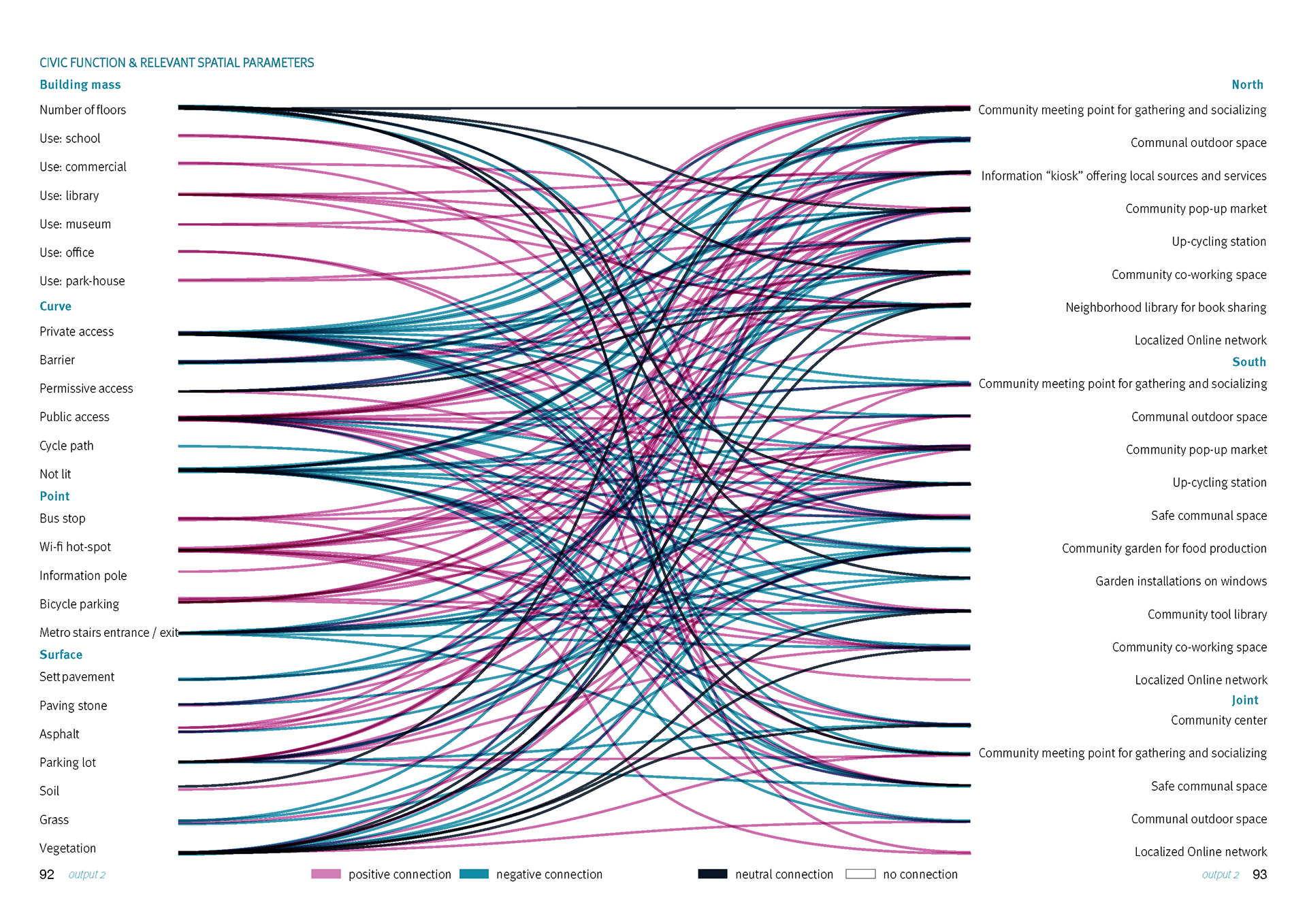
CIVIC FUNCTION & RELEVANT PARTICIPATION TYPES & SPATIAL LOGIC = WEIGHTED CITY GRAPH
Utilizing Space Syntax, a methodology for the simulation of human activity within urban settings, the analysis challenges the notion that urban space is a background for human activity. The urban fabric is rather configurational and influences individual experiences in the network. Factoring representations of space, analysis of spatial relations, and interpretive models, Space Syntax aims to represent human movement. (Hillier and Hanson, 1984)
Citation formats:
APA Style: Barashkov, J. (2023). A digital toolbox for bottom-up interventions in Berlin - Re-commoning urban spaces from the bottom-up in Kottbusser Tor (Master's thesis). DOI: 10.13140/RG.2.2.21980.19844
Chicago Style: Barashkov, Julia. "A Digital Toolbox for Bottom-Up Interventions in Berlin - Re-commoning Urban Spaces from the Bottom-Up in Kottbusser Tor." Master's thesis, M.A. Architecture, advised by Prof. Dipl.-Ing. Martin Wollensak and Prof. Dr.-Ing. Jörg Rainer Noennig, July 2023. DOI: 10.13140/RG.2.2.21980.19844.
MLA Style: Barashkov, Julia. A Digital Toolbox for Bottom-Up Interventions in Berlin - Re-commoning Urban Spaces from the Bottom-Up in Kottbusser Tor. Master's thesis, M.A. Architecture, advised by Martin Wollensak and Jörg Rainer Noennig, July 2023. DOI: 10.13140/RG.2.2.21980.19844.